
A few years ago, I walked into a manufacturing plant that was proud of its ERP system. And to be fair, it could do almost everything.
Advanced scheduling.
Custom shop-floor dashboards.
Automated exception routing.
Half a dozen integrations.
The works.
The problem wasn’t capability. It was ERP complexity in manufacturing.
The production manager pulled me aside and said something I’ve heard more than once: “We don’t really use it the way it was designed anymore. We just work around it.”
What started as smart enhancements had quietly become configuration sprawl. New features were layered in to solve edge cases. Custom logic handled one-off scenarios.
Over time, the system became harder to operate consistently than the production floor it was meant to support.
In manufacturing, complexity doesn’t scale. It compounds.
And when ERP complexity in manufacturing compounds, it rarely shows up as a dramatic failure. It shows up as variability. Exceptions. Extra approvals. Minor delays. Small inefficiencies.
Until one day, margin starts slipping and no one can pinpoint exactly why.
This series at a glance
This article is the first of a three-part executive series built to help CFOs and COOs evaluate ERP decisions through the lens of reliability, margin protection, and operational discipline.
Here I’ll explain why piling on ERP features rarely improves performance. In the following posts I’ll reveal the hidden cost of overengineering ERP in distribution operations, and why operational control is not automation... it’s discipline.
The manufacturing performance paradox
Manufacturers rarely struggle because their ERP can’t do enough.
They struggle because the system becomes too complex to run reliably.
Research from MIT Sloan has highlighted the broader productivity paradox in manufacturing — digital investments don’t automatically translate into productivity gains. Technology expands capability. But without operational discipline, performance stalls.
That paradox is exactly what we see inside ERP environments.
Leaders often confuse:
- Capability with reliability
- Feature access with process maturity
- Optionality with governance
- Speed of implementation with speed of execution
In theory, more ERP functionality should improve manufacturing ERP performance. In practice, it often introduces variability.
And variability is the enemy of throughput.
What makes this paradox persistent is that expanding capability feels like strategic investment. It appears proactive. But when discipline doesn’t scale at the same rate, the financial return flattens.
From a capital allocation standpoint, that distinction matters. Without strong ERP governance in manufacturing, additional capability behaves less like strategic leverage and more like operating expense.
In manufacturing and distribution environments, this erosion often appears first as “small inefficiencies” — minor scheduling overrides, slightly higher freight, incremental labor adjustments. None of them look strategic. All of them compound.
That compounding effect becomes even more visible in distribution operations, where seconds per order directly translate into margin. (That’s exactly what I'll examine in the next installment in this series.)
Why doesn’t adding more ERP features automatically improve manufacturing performance?
Adding features increases configuration surface area.
Each new scheduling parameter, exception rule, approval flow, integration, or customization introduces new decision branches. More branches mean more places for drift/creep.
Without strong ERP governance in manufacturing, those branches multiply faster than they can be standardized.
It's a predictable pattern:
- A feature is added to solve a legitimate operational pain.
- An edge case appears.
- Custom logic is introduced to handle it.
- Documentation lags.
- Training becomes inconsistent.
- Workarounds become the “real process.”
That’s how ERP feature sprawl takes root. It doesn’t happen through recklessness. It happens through well-intentioned problem-solving.
But over time, the system becomes less predictable... and manufacturing depends on predictability.
ERP complexity in manufacturing and the complexity cascade
Complexity fails in repeatable ways.
Think of it like adding gears to a machine. One or two additional gears can improve torque. Add too many without recalibrating the system, and friction increases. Eventually, the machine generates more heat than motion.
ERP behaves the same way.
Here is the Complexity Cascade we see repeatedly in manufacturing environments:
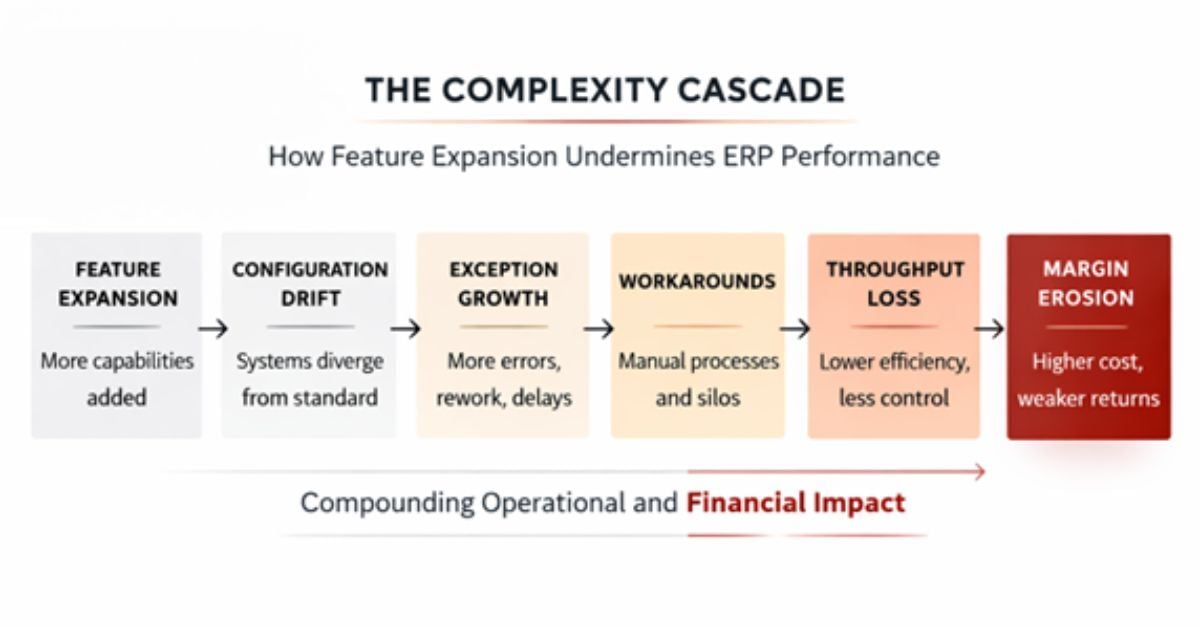

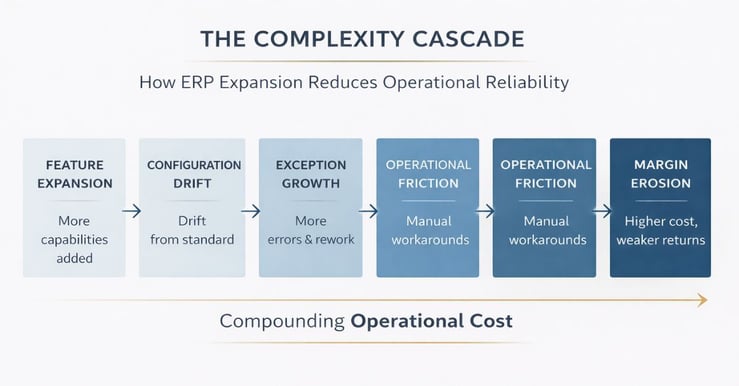
Let’s walk through a hypothetical production scenario.
Step 1: Production scheduling
A manufacturer adds advanced scheduling logic to optimize sequencing. Initially, it works.
Then:
- A few rush orders require overrides.
- Supervisors begin manually adjusting priority.
- Planners introduce temporary scheduling exceptions.
- Those exceptions are never retired.
Over time, formal change control discipline weakens. Temporary adjustments bypass structured review, and shop floor execution consistency begins to vary by shift or supervisor.
The system may remain technically sound, but operational consistency erodes.
Soon, the “automated” schedule is only loosely trusted, as planners double-check everything manually.
Operational impact:
- Planning time increases.
- Expedites increase.
- Floor supervisors revert to spreadsheets.
Financial impact:
- More labor hours.
- Overtime.
- Increased WIP volatility.
Step 2: Master data integrity
Now layer in complexity within items, BOMs, and routings. As features expand, we begin to see the following:
- Variants multiply.
- Routings are adjusted for exceptions.
- Temporary changes remain permanent.
- Documentation lags behind.
- Inventory accuracy begins to drift.
- Quality traceability becomes harder.
- Operational impact:
- Rework increases.
- Scrap grows quietly.
- Cycle counts uncover surprises.
Financial impact:
- Margin variance.
- Write-offs.
- Safety stock inflation.
This is where ERP reliability vs capability becomes visible. The system may be capable of extraordinary sophistication. But reliability — consistent, repeatable execution — is what drives performance.
Quality traceability is often where this drift becomes visible.
When lot tracking rules vary across plants, when temporary inspection overrides remain active, or when serial entry discipline differs by shift, traceability technically exists — but reliability weakens.
In a recall scenario, that difference matters. Operationally, teams pause production to reconcile exposure. Financially, recovery labor spikes, expedited remediation costs increase, and compliance scrutiny intensifies.
The feature is there. The governance isn’t.
What are the hidden financial costs of ERP feature sprawl for manufacturers?
From a CFO perspective, complexity is a tax you pay every day.
Here’s how it compounds.
-
Scrap and Rework: Small inconsistencies in routings or data standards increase defect rates. Even a 0.5% increase in rework across high-volume production can erase millions in annual margin.
-
Downtime Recovery: If scheduling logic and shop-floor execution are misaligned, recovery from disruptions takes longer. Throughput drops. Overtime rises.
-
Expediting and Freight: Minor planning inefficiencies multiply. A few expedited shipments per week become hundreds per year.
- Labor Inflation: When ERP is inconsistent, labor fills the gap. More planners. More analysts. More exception managers.
This is how ERP complexity in manufacturing quietly appears on financial statements. Not as “software cost,” but as operating expense.
A CFO-level compounding cost model
Let’s take a look at a conservative example for a mid-sized manufacturer:
Assume this manufacturer processes 10,000 ERP production transactions per week (confirmations, postings, adjustments, reviews), and each transaction adds 12 seconds of additional handling due to manual overrides, exception reviews, or reconciliation.
Here’s what that looks like:
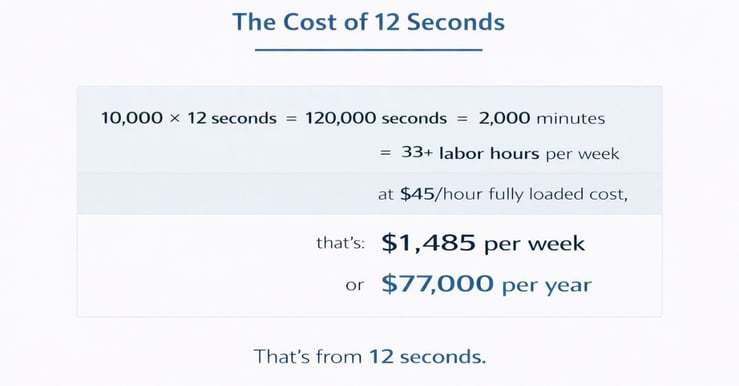
Now multiply this across order processing, scheduling, receiving, quality checks, and shipping documentation.
The compounding effect becomes material quickly... and that’s before considering throughput loss.
ERP complexity in manufacturing and the upgrade avoidance spiral
One of the clearest warning signs of unmanaged complexity is upgrade hesitation.
Customization makes upgrades harder --> Harder upgrades get delayed --> Delayed upgrades increase technical debt --> Technical debt increases fragility.
McKinsey has written extensively about ERP platform modernization and the importance of simplification before transformation. Organizations that layer complexity without governance pay twice... once in implementation and again in ongoing maintenance.
When upgrades are avoided:
- Security risk increases.
- Integration compatibility degrades.
- Partner dependence rises.
- Internal confidence drops.
Operationally, teams begin designing around system limitations instead of strengthening the foundation.
And that’s the opposite of manufacturing operational control.
What actually improves manufacturing ERP performance?
If more features don’t automatically improve performance, what does?
Not more capability... More control.
The highest-performing manufacturing environments I’ve worked with tend to share a pattern. They run simpler ERP environments with stricter governance.
They prioritize ERP governance in manufacturing before expansion.
They treat ERP like infrastructure — not a playground.
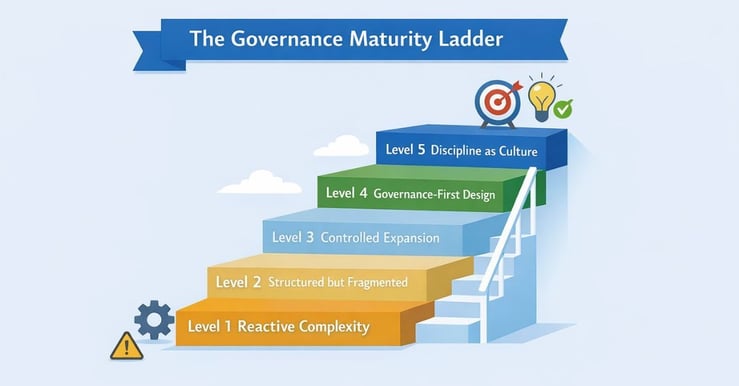
The governance maturity ladder
Level 1: Reactive complexity
- Customizations approved informally
- No named process owners
- Edge cases drive configuration
- Upgrade fear is high
Level 2: Structured but fragmented
- Some documentation exists
- Change requests tracked inconsistently
- Testing discipline uneven
Level 3: Controlled expansion
- Named process owners for production, inventory, quality
- Formal change control board
- Enhancements require a business case
At this stage, organizations begin stabilizing ERP complexity in manufacturing rather than expanding it blindly.
Level 4 — Governance-first design
- Out-of-the-box prioritized
- Minimal viable configuration
- Standardized master data policies
- Consistent test environments
- Upgrade cycles become predictable.
- Exception rates are measured and reduced.
- Complexity is added only when discipline proves capable of supporting it.
Level 5 — Discipline as culture
- Features are evaluated against operational consistency
- Exceptions are treated as design failures
- Performance discussions center on reliability
- CFO and COO share ownership of ERP governance
At Level 5, ERP reliability vs capability is no longer theoretical. It’s measurable.
And performance becomes more stable.
Should manufacturers start with out-of-the-box ERP before customizing?
Short answer: yes.
Long answer: yes — because governance scales better than customization.
Out-of-the-box configuration reduces testing burden.
It reduces upgrade risk.
It enforces standardized workflows.
Forrester’s ERP market research consistently highlights that organizations achieving the strongest ROI are those that limit customization and modernize with discipline rather than expansion.
Customization should follow proven process maturity, not precede it. When customization leads maturity, complexity outruns control.
And that’s where ERP feature sprawl resurfaces.
A distribution preview: Seconds per order
Although my next blog in this series goes deeper into distribution, consider a simple preview.
If a distribution operation processes 5,000 orders per week and complexity adds 8 seconds of extra validation per order due to layered rules and manual review:
5,000 × 8 seconds = 40,000 seconds = 11 labor hours per week.
Across a year, that’s nearly 580 hours of labor.
Now consider:
- Returns handling
- EDI exception review
- Freight adjustments
- Warehouse override approvals
Seconds compound.
That’s how ERP complexity in manufacturing and distribution quietly erodes speed.
And in distribution, speed is margin.
Executive checklist before adding ERP features
Before approving new features or customizations, leadership should ask:
- Do we have named process owners for production, inventory, and quality?
- Are master data standards enforced and audited?
- Do we measure exception rates against transaction volume?
- Is there formal change control discipline?
- Can we upgrade without fear?
- Are we solving root causes — or designing around behavior?
If these answers are unclear, adding features will likely increase variability, not performance.
The core doctrine
High-performing manufacturers do not win because their ERP does more. They win because ERP does what it’s supposed to do — consistently.
They measure exceptions. They protect data integrity. They control configuration growth.
They treat ERP complexity in manufacturing as something to manage, not celebrate.
The financial framing
For CFOs, the question is not:
“How advanced is our ERP?”
It’s:
“How reliably does our operation execute?”
Because reliability protects:
- Throughput
- Margin
- Working capital
- Upgrade cadence
- Audit confidence
Complexity, unmanaged, erodes each of those quietly.
And that erosion rarely shows up as a headline problem. It shows up as:
- Slightly higher labor
- Slightly higher freight
- Slightly higher scrap
- Slightly slower production
Variability reduces forecast confidence. And when forecast confidence declines, capital planning becomes more conservative — which quietly constrains growth.
Until predictability disappears.
Chris’s practical rule
Add capability only when you’ve proven you can operate it consistently.
Why are we making this change? Does it add value for our customers? Is the way the system normally operates truly unacceptable?
Discipline before expansion.
Governance before enhancement.
Control before automation.
Because in manufacturing, performance isn’t constrained by software limits.
It’s constrained by how reliably you can run what you’ve built.
The series continues
This article is the first in a three-part executive series on operational control in manufacturing and distribution ERP.
My next installment examines how overengineering erodes distribution speed and margin.
Then finally, I clarify why operational control is discipline — not automation.
If your ERP environment feels more capable each year but not more predictable, the next step is understanding where that complexity is quietly costing you.
For a practical, 30-minute look at managing Business Central SaaS environments—from update planning to extensions and data protection—join popular monthly Coffee with Chris sessions, focused on real-world operating best practices.