For manufacturers weighing Syspro vs Business Central after Syspro’s move to subscription pricing, the question worth asking isn't just how to absorb the cost; it's whether that spend could instead fund a platform with more room to grow. Microsoft Dynamics 365 Business Central offers native integration with the Microsoft tools most teams already use, a broad partner and app ecosystem, and a clearer path to scale than re-signing for the same system at a higher price.
Nobody enjoys a forced renewal at a higher price. But every so often, a forced renewal is also a forced decision point, and forced decision points have a way of surfacing questions a business has been putting off.
For a lot of Syspro customers, the question underneath the frustration isn't really "how do we avoid this cost." It's closer to: "if we're going to pay more either way, are we at least getting more for it?"
That's the mindset behind the Expand path in this series. It's not about replacing Syspro with something bigger for its own sake. It's about recognizing that a mandatory cost increase is a legitimate moment to ask whether the platform underneath the business should be doing more than it currently does.
Why would a manufacturer move from Syspro to Business Central?
The manufacturers we hear this from tend to share a few things in common. They're not necessarily underusing Syspro; in fact, many are running it hard.
But they've also hit friction that's been easy to live with until a licensing change prompted a closer look: reporting that requires exporting to Excel for anything beyond the basics, integrations with other business systems that go through custom middleware instead of native connections, or a partner network that feels thinner than what they'd get elsewhere.
None of that is necessarily a knock on Syspro's manufacturing depth. It's a statement about the surrounding ecosystem, and for growing businesses, the ecosystem often matters as much as the core module set.
Is Microsoft Dynamics 365 Business Central a good alternative to Syspro?
It can be, particularly for manufacturers that value Microsoft ecosystem integration, reporting, extensibility, and broader business management capabilities.
The clearest advantage Business Central brings to this conversation isn't a single feature; it's the fact that it's part of the Microsoft stack many manufacturing teams are already living in.
Native Office and Teams integration: Quotes, purchase orders, and reports that open directly in Excel and Outlook without export steps or add-ins, because the underlying platform is the same one your team already uses every day.
Power BI built in: Dashboards and drill-down reporting are native to the platform rather than bolted on, which matters for the exact reporting friction that pushes manufacturers to reevaluate their ERP in the first place.
The Power Platform: Power Automate and Power Apps let teams build lightweight workflow automation and custom apps around Business Central without a full development project, something that typically requires a partner engagement in a standalone ERP.
Microsoft Copilot: Microsoft has embedded many AI features into Business Central. Monotonous tasks like bank reconciliation, summarizing inventory transaction data, and creating item attributes by uploading an image are just the beginning of what these features already do in the solution! AI Agents will help create orders, purchase invoices, and drive new features that improve customer service.
A path to grow further: If the business eventually require more, whether that's multi-entity complexity, deeper supply chain requirements, or global operations, there's a defined path to Dynamics 365 Finance & Supply Chain Management.
How does Syspro compare with Business Central for manufacturing?
|
|
Syspro (subscription) |
Business Central |
|
Ecosystem integration |
Integrates with Microsoft and third-party applications |
Built-in integrations with Microsoft 365 and Power BI |
|
Extensibility & Automation |
Custom development via Syspro's own tools and partner network |
Power Platform, including Power Automate, Power Apps, and Copilot Studio |
|
Reporting & analytics |
Embedded BI, third-party tools common for advanced needs |
Power BI integration with embedded reporting an analytics |
|
Partner ecosystem |
Syspro relies on a relatively concentrated network of specialized ERP partners |
One of the largest ISV and partner ecosystems in business applications |
|
Growth path |
Scales within Syspro's own tiering |
Can transition to Dynamics 365 Finance and Supply Chain Management as requirements grow. |
This isn't a claim that Business Central out-manufactures Syspro on every dimension. Discrete manufacturing depth is a genuine Syspro strength, and any serious evaluation should stress-test Business Central's manufacturing module against your specific processes before committing.
In a Syspro to Business Central comparison, what matters most is total platform value for the spend, not module against module.
What should manufacturers evaluate before moving from Syspro to Business Central?
Manufacturers should look beyond comparing manufacturing features and evaluate what they could gain from moving to a more connected Microsoft ecosystem, creating opportunities to improve reporting, automate processes, strengthen collaboration, and reduce disconnected systems.
The evaluation should consider how well Business Central supports current manufacturing requirements, but also where the broader Microsoft platform could simplify operations, improve visibility, reduce manual work, and support future growth.
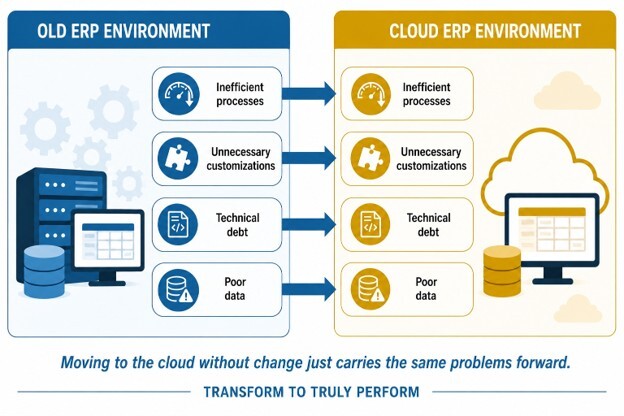
Existing customizations, integrations, data, and processes should then be reviewed to determine what still adds value, what can be replaced by standard Microsoft capabilities, and what may no longer be necessary.
This path fits manufacturers who were already feeling friction outside the core manufacturing modules—with reporting, integration, or extensibility—and are looking at the licensing change as a reason to finally address those issues.
Syspro vs Business Central: What comes next?
If Syspro’s pricing change has put your ERP strategy back on the table, don’t start by asking which platform costs less. Ask which investment will give your business the capabilities, flexibility, and room to grow it needs over the next five to ten years.
That means looking at the bigger picture: your manufacturing requirements, reporting gaps, integrations, manual processes, Microsoft investments, customizations, and growth plans. The goal isn’t simply to replace Syspro. It’s to determine whether staying with Syspro, moving to Business Central, or simplifying onto SAP Business One creates the strongest long-term value for your business.
If Business Central emerges as the right direction, the next question is how to get there without disrupting production schedules, financial close, or customer commitments.
The next post in this series walks through what a move from Syspro to Business Central looks like in practice, including migration timelines, planning considerations, and how to protect historical data through the transition.