

Manufacturing companies evaluating SAP Business One for Manufacturing often reach a point where operational complexity outpaces the capabilities of entry-level systems.
Inventory is tracked in one tool.
Financials live in another.
Production planning relies on spreadsheets.
Reporting requires manual consolidation.
As order volume increases and supply chains become more volatile, disconnected systems begin to limit visibility and slow decision-making.
At that stage, the issue is not effort — it's integration.
SAP Business One for Manufacturing is an ERP platform that unifies financials, inventory, production planning, and reporting into a single system designed for growing manufacturers.
SAP Business One is also included on Forbes Advisor's list of the Best Manufacturing ERPs of 2025, reinforcing its relevance for manufacturers that need operational control without enterprise-scale complexity.
This guide explains:
- What SAP Business One does specifically for manufacturers
- Where it fits operationally
- The six practical reasons growing companies choose it
- When it makes sense — and when it may not
The goal is clarity. ERP selection should be an operational decision, not a software trend.
1. Eliminate Disconnected Systems and Gain a Single Source of Truth
Most growing manufacturers do not struggle because they lack tools.
They struggle because their tools are not connected.
Accounting may run in one system. Inventory may live in another. Production schedules are managed in spreadsheets. Shop floor updates and reporting require manual reconciliation across departments.
As transaction volume increases, this fragmentation creates:
- Duplicate data entry
- Inventory discrepancies
- Delayed financial reporting
- Limited visibility into work orders and production status
- Inconsistent product costing and margin analysis
Over time, the cost of disconnection compounds.
SAP Business One for Manufacturing centralizes financials, inventory, purchasing, and production data into a single integrated ERP platform.
This matters because production orders, inventory movements, and purchasing transactions update costing and financial reporting automatically — without spreadsheet reconciliation.
When a production order is released, inventory availability and component demand are visible immediately.
When materials are received, inventory and accounts payable update automatically.
When a sales order ships, revenue, COGS, and margin are reported based on actual operational activity.
Operational execution and financial reporting are no longer separate conversations.
|
Feature |
Before SAP Business One |
With SAP Business One |
|
Reports |
Multiple sources, manual reconciliation needed |
Unified platform, quick generation |
|
Inventory Management |
Separate systems, duplicate data entry |
Single system, real-time tracking |
|
Order Management |
Different software for different tasks |
Integrated, streamlined process |
|
Financial Management |
Multiple accounting tools, complex consolidation |
Centralized financial monitoring and control |
|
Data Access |
Scattered across various systems |
All critical data is accessible in one place |
|
Productivity |
Time-consuming and error-prone |
Increased efficiency, fewer errors |
For leadership teams, that typically translates into:
- Faster month-end close
- More reliable inventory valuation
- Real-time product and order-level margin visibility
- Fewer spreadsheet-based workarounds across operations and finance
Instead of reconciling systems, teams can focus on operational performance.
How does SAP Business One reduce manual reconciliation?
By keeping purchasing, production, inventory, and financial postings in one system, operational transactions automatically update financial reporting in real time, so finance and operations work from the same data.
2. Align Production Planning with Real-Time Material and Demand Data
Production delays are rarely caused by a lack of effort.
More often, they stem from limited visibility.
When production planning relies on spreadsheets or static reports, manufacturers risk:
-
- Releasing work orders without confirming material availability
- Expediting components due to last-minute shortages
- Overproducing slow-moving items
- Missing delivery commitments because purchasing and production are not aligned
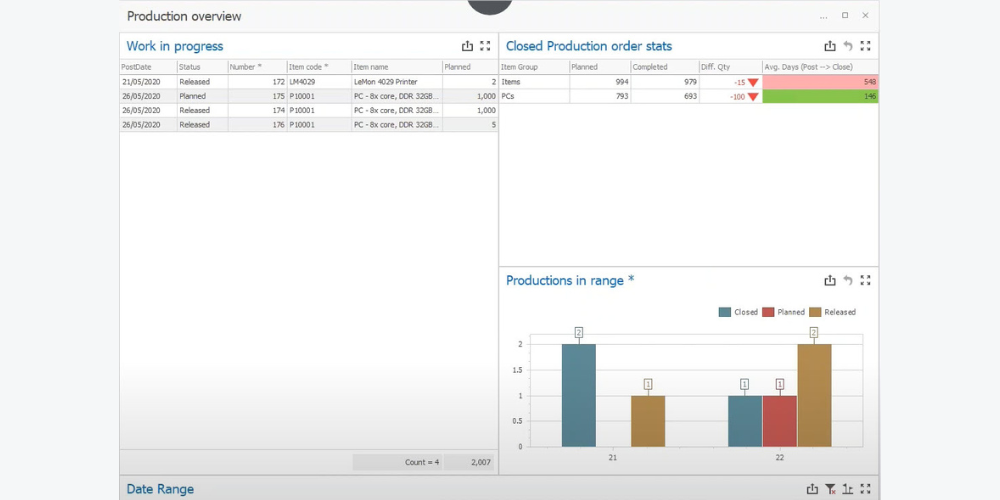
As complexity increases, manual planning becomes unreliable.
SAP Business One for Manufacturing includes built-in Material Requirements Planning (MRP) that integrates demand forecasts, bills of materials (BOMs), inventory levels, and purchasing lead times in a single system.
Instead of planning in isolation, manufacturers can evaluate:
- Component availability before releasing production
- Purchase recommendations based on actual demand
- Projected shortages before they disrupt schedules
- Capacity constraints across work centers
This reduces reactive decision-making.
When MRP is aligned with real-time inventory and purchasing data, production schedules become more predictable and less dependent on manual intervention.
What does MRP in SAP Business One actually do?
It analyzes current inventory, open sales orders, production demand, and supplier lead times to generate purchasing and production recommendations that support on-time delivery and cost control.
For leadership teams, the operational impact typically includes:
- Fewer emergency purchase orders
- Improved on-time delivery performance
- Reduced excess inventory
- Better alignment between sales forecasts and production schedules
Rather than managing material shortages after they occur, manufacturers gain visibility early enough to adjust purchasing or scheduling decisions.
As production volume grows, that shift from reactive to planned execution becomes increasingly important.
3. Strengthen Cost Control and Gain Real-Time Margin Visibility
For many manufacturers, profitability is unclear because margins are thin.
It's unclear because visibility is delayed.
When production data, purchasing costs, and financial reporting live in separate systems, leadership often learns about margin erosion after the fact — during month-end close or quarterly review.
By then, corrective action is reactive.
SAP Business One for Manufacturing connects operational activity directly to financial outcomes. Production orders, material issues, labor entries, and purchasing transactions flow into costing and financial reporting in real time.
That alignment allows manufacturers to track:
- Job and production order costing
- Product-level gross margin
- Customer-specific profitability
- Landed costs, including freight and duties
- Variances between planned and actual production costs
Instead of estimating profitability based on assumptions, leadership teams can review performance based on actual operational data.
How does SAP Business One improve manufacturing cost visibility?
By linking bills of materials (BOM), labor, overhead, and purchasing data directly to financial reporting, the system calculates product and order-level margins as transactions occur — not weeks later.
This level of transparency supports better decisions around:
- Pricing adjustments
- Supplier negotiations
- Production scheduling
- Product line rationalization
When cost data is accurate and timely, manufacturers can identify margin pressure early and adjust before small inefficiencies compound.
As operations scale, this connection between production execution and financial reporting becomes increasingly important.
4. Improve Traceability, Quality Control, and Compliance Readiness
As manufacturing operations grow, traceability becomes more complex.
Lot tracking, serial numbers, expiration dates, supplier certifications, and quality documentation all require consistency. When those records live in spreadsheets or disconnected systems, audit readiness becomes reactive.
In regulated industries, especially, documentation gaps create operational risk.
SAP Business One for Manufacturing provides structured lot and serial traceability tied directly to inventory, purchasing, production, and financial records.
This allows manufacturers to:
- Track raw materials from supplier to finished goods
- Trace finished products back to component batches
- Monitor lot and serial numbers across warehouses
- Maintain inspection and quality records
- Support recall management with faster root-cause identification
Instead of searching across systems during an audit or quality event, operational and financial records are aligned.
How does SAP Business One support manufacturing traceability?
By linking lot and serial tracking to purchasing, inventory movements, production orders, and sales transactions, the system maintains a continuous audit trail across the product lifecycle.
This matters in situations such as:
- Customer quality disputes
- Product recalls
- Regulatory audits
- Certification renewals
When traceability is structured within the ERP system, compliance becomes a managed process rather than a manual exercise.
As production volumes and SKU counts increase, structured documentation reduces risk exposure and protects brand reputation.
5. Improve Inventory Control and Warehouse Efficiency
Inventory is often the largest asset on a manufacturing company's balance sheet.
When visibility is limited, the consequences are immediate:
- Excess stock tying up working capital
- Stockouts disrupting production
- Manual cycle counts correcting inaccurate balances
- Emergency purchasing increases costs
Disconnected systems and delayed updates make it difficult to trust on-hand quantities.
SAP Business One for Manufacturing provides real-time inventory visibility across warehouses, bins, and production locations.
Instead of relying on periodic reconciliations, manufacturers can track:
- On-hand, committed, and available inventory
- Multi-warehouse stock levels
- Bin-level locations for improved picking accuracy
- Lot and serial-controlled materials
- Inventory valuation methods (FIFO, moving average, standard cost)
Inventory transactions — including receipts, issues, transfers, and production consumption — automatically update financial records.
This alignment improves both operational execution and financial accuracy.
How does SAP Business One improve inventory accuracy?
By linking purchasing, production, warehouse movements, and sales fulfillment in one system, inventory balances reflect real-time operational activity rather than delayed spreadsheet updates.
For operations and finance teams, that typically results in:
- Fewer stock discrepancies
- Reduced carrying costs
- Improved inventory turnover
- Better alignment between purchasing and production demand
- Stronger working capital management
As SKU counts grow and warehouse complexity increases, structured inventory control becomes less about convenience and more about stability.
Manufacturers that rely on manual inventory processes often discover limitations only after growth accelerates.
With centralized visibility, inventory management becomes proactive rather than corrective.
6. Support Scalable Growth Without Replacing Your ERP Again
Growth introduces complexity.
More SKUs.
More locations.
More users.
More regulatory requirements.
More reporting expectations from leadership and investors.
Many manufacturers reach a point where their entry-level systems cannot scale with operational demands.
The result is often a second system replacement within a few years.
ERP selection should reduce that risk — not postpone it.
SAP Business One for Manufacturing is designed to support growing organizations without requiring enterprise-level infrastructure.
As operations expand, the system can accommodate:
- Additional warehouses and production facilities
- Increased transaction volume
- Multi-currency and multi-entity structures
- Expanded product lines and BOM complexity
- Integration with shop floor systems and third-party applications
Because financials, inventory, production, and reporting are already unified, scaling does not require layering additional disconnected tools.
The system also supports flexible deployment options (cloud or on-premises). It can run on either Microsoft SQL Server or SAP HANA, allowing manufacturers to align infrastructure with internal IT strategy.
When does SAP Business One make sense for growing manufacturers?
It is typically a strong fit for small- to midsize manufacturing organizations that have outgrown accounting software but do not require the global complexity of enterprise ERP platforms such as SAP S/4HANA.
The goal is not simply to implement an ERP system.
It is to implement a platform that supports operational maturity over time.
For manufacturers planning expansion — whether through increased production capacity, additional locations, or new product lines — selecting a system that scales without frequent replacement reduces long-term disruption and cost.
ERP should become a foundation for growth, not a recurring transition.
Is SAP Business One the Right Fit for Your Manufacturing Business?
ERP selection is not simply a feature comparison.
It is an operational decision.
SAP Business One for Manufacturing is often a strong fit when:
- You are outgrowing spreadsheets or entry-level accounting systems
- Inventory accuracy is inconsistent across warehouses
- Production planning relies on manual coordination
- Financial reporting requires significant reconciliation
- Leadership lacks real-time visibility into margin and operational performance
- Growth plans include additional SKUs, facilities, or entities
At this stage, the issue is typically not software capability — it is system integration and process alignment.
However, SAP Business One may not be the best fit in every scenario.
It may be less appropriate if:
- You operate at a global enterprise scale, requiring highly complex compliance frameworks
- You require deeply specialized industry modules beyond standard manufacturing ERP capabilities
- Your IT strategy mandates a fully SaaS-only environment without infrastructure flexibility
- Your operational model aligns more closely with enterprise-tier ERP platforms
ERP selection should align with:
- Production complexity
- Reporting requirements
- Infrastructure strategy
- Internal IT capacity
- Long-term growth objectives
A structured evaluation process — including workflow mapping, data review, and deployment planning reduces implementation risk and improves long-term outcomes.
The goal is not to implement software quickly.
The goal is to implement the right platform deliberately.
How Manufacturers Are Using SAP Business One in Practice
ERP value is best understood through outcomes — not feature lists.
Over the years, Clients First has worked with manufacturing organizations across industries, helping them modernize financial systems, improve production visibility, and scale operations responsibly.
Our work has also been recognized within SAP's Intelligent Enterprise Program for integrations involving MES Sensor Technology and Batch Processing Pour Level systems.
Below are examples of how manufacturers have used SAP Business One to improve operational performance:
Upgraded from QuickBooks to SAP Business One to improve scalability and integrate existing systems. The built-in MRP tools provided better production visibility and planning discipline.
Doubled production capacity to 80 million cans per year during rapid demand growth, significantly reducing downtime through improved system alignment.
Increased revenue by 10% after optimizing inventory control and improving operational training around SAP Business One usage.
Eliminated complex workarounds by consolidating processes into a single system, supporting 38% annual revenue growth.
Automated 90% of record-keeping processes, improving reporting accuracy and audit readiness through system ownership and process alignment.
These examples reflect a common pattern:
- Improved visibility
- Reduced operational friction
- Stronger production planning
- Better financial control
ERP success depends not only on platform selection, but on disciplined implementation and operational alignment.
Next Steps: Evaluating SAP Business One for Your Manufacturing Operation
Selecting an ERP system is one of the more consequential operational decisions a growing manufacturer will make.
The right platform should:
- Integrate financials, inventory, and production
- Improve planning reliability
- Provide real-time cost and margin visibility
- Support traceability and compliance
- Scale without requiring replacement as complexity increases
SAP Business One for Manufacturing addresses these areas for many small and midsize manufacturers. When implemented strategically, it becomes more than a system upgrade. It becomes a foundation for operational clarity and financial control.
That said, software alone does not determine success.
Fit depends on how well the system aligns with your workflows, reporting expectations, deployment strategy, and growth plans.
At Clients First™ Business Solutions, our approach begins with an operational evaluation not a generic demo.
We review:
- Current production workflows
- Inventory structure and warehouse complexity
- Financial reporting requirements
- Integration needs (EDI, shipping, shop floor systems)
- Long-term expansion plans
From there, we determine whether SAP Business One is the right fit or whether another ERP platform would better align with your objectives.
If you are evaluating ERP modernization for your manufacturing operation, the next step is clarity.
Schedule a structured assessment to determine whether SAP Business One supports your operational model, growth trajectory, and reporting requirements.
ERP is not just a software investment.
It is an operational foundation.