
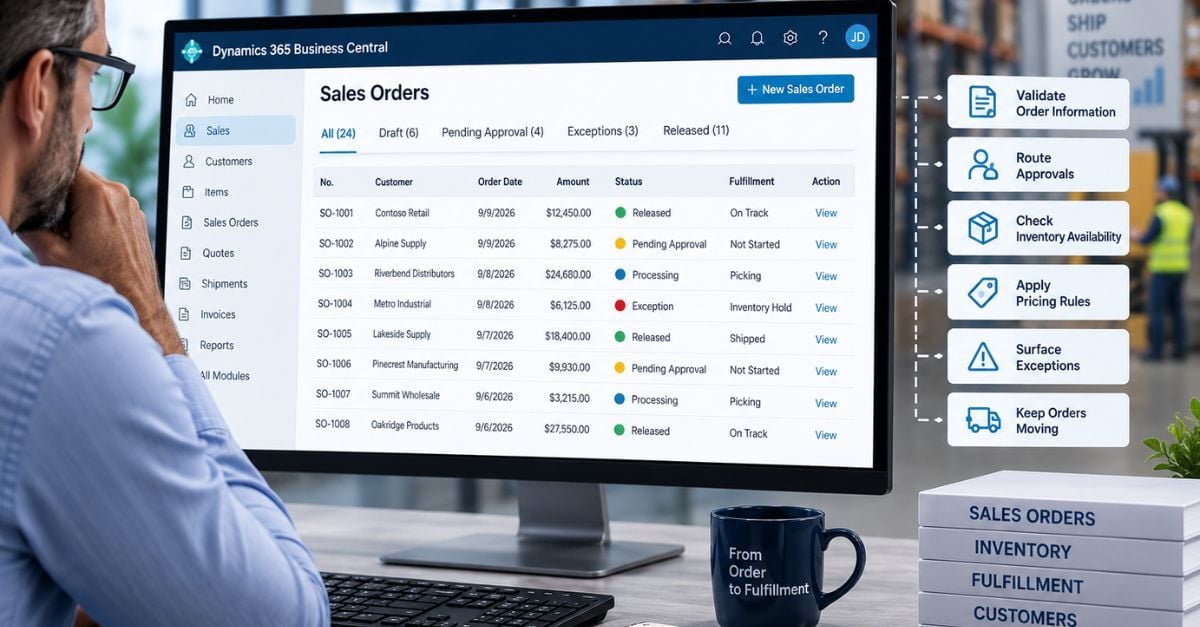
Sales Order Agent in Business Central Explained
Order processing has always been one of the most operationally sensitive workflows inside ERP systems.
A delayed sales order does not simply affect data entry.
It can affect:
- inventory allocation,
- fulfillment timing,
- production scheduling,
- shipping coordination,
- customer communication,
- and revenue visibility across the business.
That is especially true for manufacturing and distribution companies where order workflows are tightly connected to purchasing, warehousing, inventory management, and customer delivery expectations.
As order volume increases, many organizations begin looking for ways to reduce the amount of manual coordination required to move orders through the system efficiently.
That often leads to discussions around sales order automation.
But most order processing problems are not caused by order entry alone.
They are caused by inconsistent operational rules.
For example:
- pricing exceptions may require manual review,
- inventory availability may change unexpectedly,
- customer information may be incomplete,
- fulfillment priorities may shift,
- or approvals may vary between departments and employees.
In many organizations, employees compensate for those inconsistencies manually over time through emails, spreadsheets, phone calls, and informal escalation processes.
Those workarounds may keep orders moving temporarily, but they become increasingly difficult to scale as operational complexity grows.
This is where the Sales Order Agent inside Microsoft Dynamics 365 Business Central introduces a different approach to workflow automation.
Instead of focusing only on faster order entry, the Sales Order Agent is designed to help organizations manage portions of the order workflow more consistently inside the ERP environment.
That may include helping:
- route orders,
- validate transaction information,
- surface exceptions,
- support approval workflows,
- and reduce repetitive administrative coordination throughout the order lifecycle.
The larger goal is not simply processing orders faster.
The goal is to improve workflow consistency while preserving operational visibility and customer accountability.
That distinction matters because sales order workflows directly affect customer experience.
If inventory data is inaccurate, pricing rules are inconsistent, or exception handling is poorly governed, automation can accelerate operational problems just as quickly as it accelerates efficiency.
For operations and finance leaders, that creates an important shift in how AI-assisted order processing should be evaluated.
The question is no longer just:
“How quickly can we enter orders?”
The better question is:
“How do we reduce operational friction without weakening visibility, fulfillment accuracy, or workflow control?”
That distinction will likely determine which organizations improve order execution successfully and which ones simply automate operational inconsistency at greater scale.
What the Business Central Sales Order Agent Automates
The Sales Order Agent inside Microsoft Dynamics 365 Business Central is designed to help organizations automate portions of the sales order workflow while maintaining operational visibility and process control.
That distinction matters because sales order workflows involve far more than entering customer orders into the ERP system.
In many manufacturing and distribution environments, order processing requires constant coordination between:
- sales teams,
- customer service,
- inventory management,
- warehouse operations,
- purchasing,
- fulfillment,
- and finance.
As order volume increases, that coordination often becomes increasingly dependent on:
- manual communication,
- spreadsheets,
- email approvals,
- institutional knowledge,
- and employees informally managing exceptions throughout the workflow.
Those processes may function adequately at smaller scale.
But they become more difficult to manage consistently as:
- transaction volume increases,
- inventory conditions change,
- pricing complexity grows,
- and customer expectations accelerate.
The Sales Order Agent is intended to help reduce portions of that administrative coordination inside the ERP workflow itself.
In practice, the Sales Order Agent may help organizations:
- process incoming order information,
- validate transaction details,
- route approvals,
- surface discrepancies,
- identify exceptions,
- and help orders move through predefined workflow paths more consistently.
For many organizations, the operational value comes less from faster order entry and more from reducing workflow interruption across the order lifecycle.
Most sales order delays are not caused by employees typing information into the ERP system.
They are caused by:
- inventory availability conflicts,
- pricing discrepancies,
- incomplete customer information,
- fulfillment constraints,
- approval inconsistencies,
- or delays resolving operational exceptions.
The Sales Order Agent may help surface those issues earlier and standardize portions of the workflow that often become fragmented under operational pressure.
That consistency becomes especially important for distribution companies managing:
- high transaction volume,
- fluctuating inventory levels,
- customer-specific pricing,
- expedited fulfillment requests,
- and tight delivery expectations.
Even small order-processing inconsistencies can create downstream operational consequences very quickly.
For example:
- inaccurate inventory allocation may delay fulfillment,
- pricing discrepancies may affect customer trust,
- incomplete order information may disrupt warehouse operations,
- or unresolved exceptions may create shipping delays and revenue disruption.
AI-assisted order workflows can help organizations identify and route those issues more consistently inside Business Central.
But the Sales Order Agent should not be viewed as a replacement for operational oversight.
It still depends heavily on:
- inventory accuracy,
- customer data quality,
- pricing governance,
- approval structures,
- and clearly defined exception management procedures.
If those operational foundations are weak, automation can accelerate fulfillment problems just as quickly as it accelerates order processing speed.
This is one reason organizations often achieve the best results when they first standardize:
- order workflows,
- pricing rules,
- inventory processes,
- customer data management,
- and escalation procedures
before expanding AI-assisted workflow automation.
The objective is not simply processing orders faster.
The objective is to reduce operational friction while helping organizations maintain:
- fulfillment visibility,
- workflow accountability,
- customer communication consistency,
- and operational control across the order lifecycle.
That is a very different goal than simply automating order entry.
Where AI Helps Distribution Companies Most
Distribution companies often operate under constant execution pressure.
Orders move quickly.
Inventory levels change continuously.
Customer expectations remain high.
Fulfillment timelines tighten.
Operational disruptions can affect multiple departments almost immediately.
Under those conditions, even small workflow inconsistencies can create significant downstream consequences.
That is one reason distribution environments are often strong candidates for AI-assisted order workflows inside Business Central.
The operational value usually comes less from eliminating order entry tasks and more from improving coordination across high-volume transaction environments.
In many distribution organizations, sales order workflows require employees to constantly manage:
- inventory availability changes,
- customer-specific pricing,
- fulfillment prioritization,
- backorders,
- shipping coordination,
- order exceptions,
- and communication between departments.
As transaction volume grows, those workflows often become increasingly dependent on:
- manual escalation,
- spreadsheets,
- email communication,
- and institutional knowledge.
Employees may spend significant time simply trying to determine:
- whether inventory is available,
- why an order is delayed,
- whether pricing was approved correctly,
- or which department is responsible for resolving an exception.
The Sales Order Agent can help reduce portions of that coordination burden by helping organizations standardize workflow execution inside the ERP environment.
For example, AI-assisted order workflows may help:
- surface inventory conflicts earlier,
- identify incomplete order information,
- route approvals more consistently,
- apply Business Central pricing to draft quotes for review,
- escalate fulfillment exceptions,
- and improve visibility into order status throughout the workflow lifecycle.
That visibility becomes especially important for distribution companies managing:
- high order volume,
- multiple warehouse locations,
- customer-specific fulfillment requirements,
- expedited shipping requests,
- and fluctuating inventory conditions.
In those environments, workflow delays rarely remain isolated.
A fulfillment issue in one area of the process may quickly affect:
- warehouse operations,
- transportation scheduling,
- customer communication,
- invoicing timelines,
- and revenue recognition visibility.
AI-assisted workflows can help organizations identify those disruptions earlier and improve consistency in how exceptions are managed across departments.
Customer communication is another area where workflow consistency becomes increasingly important.
In many distribution environments, customers expect:
- rapid order confirmation,
- accurate fulfillment estimates,
- timely shipment updates,
- and immediate visibility into delays or inventory constraints.
When order workflows become fragmented, customer service teams often spend large amounts of time manually investigating:
- inventory availability,
- fulfillment status,
- pricing issues,
- shipping delays,
- or unresolved order exceptions.
The Sales Order Agent may help improve operational visibility so those issues can be surfaced and managed more consistently inside Business Central workflows.
But AI-assisted order processing still depends heavily on operational accuracy.
If:
- inventory data is unreliable,
- pricing governance is inconsistent,
- customer records are incomplete,
- or fulfillment workflows vary between departments,
automation can accelerate operational confusion just as quickly as it accelerates order flow.
This is one reason distribution companies should approach AI-assisted order workflows carefully.
The organizations likely to benefit most are usually the ones that already maintain:
- disciplined inventory processes,
- standardized order workflows,
- reliable customer data,
- consistent pricing governance,
- and clearly defined exception escalation procedures.
That operational maturity creates the conditions necessary for automation to improve workflow execution at scale.
The goal is not simply faster order processing.
The goal is to reduce operational friction while improving:
- fulfillment visibility,
- workflow coordination,
- customer responsiveness,
- and execution consistency across the order lifecycle.
That distinction often determines whether AI-assisted order workflows strengthen distribution operations or simply automate instability at greater speed.
Why Pricing and Customer Data Accuracy Matter
AI-assisted order workflows depend heavily on data consistency.
As organizations expand automation inside Business Central, pricing accuracy and customer data quality become some of the most important operational foundations supporting reliable order execution.
That is because the Sales Order Agent relies on structured ERP information to help:
- validate transactions,
- route workflows,
- identify exceptions,
- support approvals,
- and maintain consistency throughout the order lifecycle.
If pricing rules or customer records are inconsistent, automated workflows become far less reliable.
In many organizations, employees compensate for weak data quality manually over time.
Customer service representatives may recognize:
- outdated pricing,
- incorrect shipping information,
- incomplete customer records,
- unauthorized discounts,
- or unusual order patterns
before those issues create larger operational problems.
As order workflows become more automated, organizations become increasingly dependent on the accuracy of the ERP data itself rather than employee intervention alone.
That creates both operational opportunity and operational risk.
Pricing governance is one of the most important areas affected by AI-assisted order workflows.
In many manufacturing and distribution companies, pricing structures are often more complex than they initially appear.
Organizations may manage:
- customer-specific pricing agreements,
- contract pricing,
- promotional pricing,
- volume discounts,
- freight adjustments,
- rebate programs,
- and territory-specific pricing exceptions.
Over time, those pricing structures can become difficult to manage consistently across departments and workflows.
When pricing governance weakens, organizations may experience:
- margin erosion,
- approval inconsistencies,
- unauthorized discounts,
- customer disputes,
- delayed order processing,
- and reduced visibility into pricing performance.
AI-assisted order workflows apply Business Central's own pricing to draft quotes and present them for human review, so pricing can be checked and adjusted before the quote reaches the customer.
But automation cannot compensate for poorly governed pricing structures indefinitely.
If pricing rules are inconsistent or approval authority is unclear, automated workflows may accelerate inaccurate pricing decisions across large transaction volumes.
Customer data quality creates similar risks.
Incomplete or inconsistent customer records may affect:
- fulfillment accuracy,
- shipping coordination,
- tax handling,
- order prioritization,
- communication workflows,
- and customer service responsiveness.
Even small customer data inconsistencies can create downstream execution problems very quickly in high-volume distribution environments.
For example:
- outdated shipping addresses may delay deliveries,
- incomplete customer instructions may disrupt fulfillment,
- inaccurate contact information may slow exception resolution,
- or inconsistent account structures may create approval confusion across departments.
The Sales Order Agent may help surface some of these inconsistencies earlier by identifying workflow exceptions and transaction irregularities inside Business Central.
But AI-assisted order workflows still depend heavily on disciplined customer data governance to operate reliably at scale.
This becomes especially important for distribution companies where customer expectations around:
- fulfillment speed,
- shipment visibility,
- pricing accuracy,
- and order responsiveness
directly affects long-term customer relationships.
A poorly governed order workflow does not simply create internal operational inefficiency.
It can affect customer trust directly.
Organizations preparing for AI-assisted order workflows should evaluate:
- pricing governance structures,
- customer master data quality,
- approval ownership,
- discount authorization procedures,
- shipping data consistency,
- and exception escalation workflows.
That operational discipline often determines whether automation improves order execution consistency or simply accelerates workflow instability.
The organizations that usually achieve the strongest long-term results are typically the ones that treat:
- pricing governance,
- customer data quality,
- and workflow standardization
as operational infrastructure rather than administrative maintenance activities.
The Sales Order Agent can help organizations process order workflows more consistently.
But consistency still depends heavily on the quality of the operational data supporting the ERP environment underneath the automation itself.
Exception Handling in Order Workflows
Sales order workflows rarely operate under perfect conditions.
Even highly standardized order environments still encounter operational exceptions that require review, escalation, and human decision-making.
That is one reason exception handling remains one of the most important operational responsibilities surrounding AI-assisted order processing inside Business Central.
The Sales Order Agent may help organizations identify and route workflow exceptions more consistently.
But automation alone cannot resolve every operational issue automatically.
In many manufacturing and distribution companies, order exceptions occur regularly due to:
- inventory shortages,
- pricing discrepancies,
- fulfillment constraints,
- shipping delays,
- customer-specific requirements,
- incomplete order information,
- or changing operational priorities.
As transaction volume increases, those exceptions can become increasingly difficult to manage consistently through manual coordination alone.
Employees often compensate by relying on:
- emails,
- spreadsheets,
- phone calls,
- informal escalation paths,
- and institutional knowledge
to keep orders moving through the process.
Those workarounds may solve immediate workflow problems temporarily.
But they also create operational inconsistency, reduce visibility, and make it harder for organizations to scale order processing reliably over time.
The Sales Order Agent can help standardize portions of exception handling by helping organizations:
- surface discrepancies earlier,
- route exceptions through predefined workflows,
- identify incomplete transactions,
- escalate approval requirements,
- and improve visibility into unresolved order issues.
That operational visibility becomes especially important in high-volume distribution environments where delays in one area of the workflow may quickly affect:
- warehouse operations,
- transportation schedules,
- customer communication,
- fulfillment timelines,
- and revenue recognition.
For example, a pricing discrepancy may initially appear to be a sales issue.
But unresolved pricing conflicts may delay:
- inventory allocation,
- shipment scheduling,
- invoicing,
- customer communication,
- and downstream fulfillment coordination.
Similarly, an inventory exception may require coordination between:
- purchasing,
- warehouse operations,
- customer service,
- and sales management
before the order can move forward appropriately.
AI-assisted workflows can help surface those dependencies faster and improve consistency in how exceptions are escalated across departments.
But organizations should be cautious about assuming automation eliminates the need for human operational judgment.
Many order exceptions still require employees to determine:
- whether a shipment should be prioritized,
- whether pricing adjustments are appropriate,
- whether inventory should be reallocated,
- whether fulfillment commitments should change,
- or whether customer communication requires escalation.
Those decisions often involve business context that extends beyond what structured ERP workflows alone can evaluate reliably.
This becomes especially important during periods of operational disruption where:
- inventory availability changes rapidly,
- customer demand fluctuates,
- transportation conditions shift,
- or fulfillment capacity becomes constrained.
Under those conditions, poorly governed order workflows can create operational instability very quickly.
Automation may accelerate workflow execution, but it can also accelerate confusion if:
- escalation procedures are unclear,
- exception ownership is inconsistent,
- inventory data is unreliable,
- or customer communication processes are fragmented.
That is why organizations preparing for AI-assisted order workflows should define:
- exception ownership,
- escalation procedures,
- approval authority,
- customer communication standards,
- and operational decision-making responsibilities
before expanding automation aggressively across the order lifecycle.
The most effective order automation strategies usually combine:
- structured ERP workflows,
- disciplined exception management,
- operational visibility,
- and ongoing human oversight.
The goal is not eliminating exceptions entirely.
The goal is helping organizations manage exceptions more consistently while preserving:
- customer accountability,
- fulfillment visibility,
- operational coordination,
- and workflow control across increasingly complex order environments.
That distinction often determines whether AI-assisted order workflows improve execution consistency or simply accelerate operational disruption at greater scale.
Operational Risks to Watch
AI-assisted order workflows can create meaningful operational improvements when processes are structured carefully.
But organizations can also create significant execution risk when they automate order workflows without strengthening operational controls at the same time.
That risk often emerges when leadership focuses primarily on order speed while underestimating the complexity of fulfillment coordination, inventory management, pricing governance, and customer communication inside the order lifecycle.
Sales order automation is not simply about processing transactions faster.
It is about managing operational execution reliably at scale.
That distinction becomes increasingly important as organizations expand AI-assisted workflows inside Business Central.
One of the most common operational risks involves inventory visibility.
If inventory data is inaccurate or delayed, automated workflows may:
- allocate unavailable inventory,
- create fulfillment delays,
- trigger inaccurate customer commitments,
- or escalate operational confusion across warehouse and customer service teams.
In high-volume distribution environments, even small inventory inaccuracies can create downstream consequences very quickly.
For example:
- orders may be prioritized incorrectly,
- shipments may be delayed unexpectedly,
- warehouse scheduling may become disrupted,
- or customer communication may become inconsistent across departments.
AI-assisted workflows can help identify some of those inconsistencies earlier.
But automation still depends heavily on accurate operational data inside the ERP environment.
Pricing governance creates another important risk area.
In many organizations, pricing structures evolve over time through:
- customer-specific agreements,
- manual overrides,
- exception approvals,
- promotional adjustments,
- and department-specific processes.
If those pricing rules are poorly governed, automated order workflows may process:
- unauthorized discounts,
- inconsistent pricing,
- margin-reducing transactions,
- or customer-specific exceptions
without sufficient operational review.
That risk becomes more difficult to manage as transaction volume increases.
Customer communication also becomes increasingly important as workflows accelerate.
Customers typically expect:
- accurate order confirmation,
- reliable shipment timelines,
- pricing consistency,
- and timely updates when fulfillment conditions change.
If operational visibility weakens, organizations may struggle to communicate:
- inventory shortages,
- shipment delays,
- fulfillment constraints,
- or pricing disputes
before customer frustration increases.
Automation may move orders through workflows more quickly, but it does not eliminate the need for operational accountability.
Exception escalation creates another major risk area.
Many organizations still rely heavily on employees to manually identify and coordinate:
- fulfillment conflicts,
- pricing disputes,
- customer-specific requirements,
- shipping constraints,
- or operational exceptions requiring management review.
As order workflows become more automated, organizations may lose visibility into those exceptions if:
- escalation ownership is unclear,
- approval authority is inconsistent,
- workflows vary between departments,
- or operational accountability is poorly defined.
That can create execution instability very quickly during periods of:
- high transaction volume,
- inventory disruption,
- seasonal demand shifts,
- or supply chain volatility.
Manufacturing and distribution companies face additional complexity because sales order workflows are closely tied to:
- purchasing,
- warehouse operations,
- transportation scheduling,
- production planning,
- and customer fulfillment performance.
A disconnected order workflow does not simply affect order processing.
It can affect operational execution across the business.
This is one reason organizations should be cautious about pursuing fully autonomous order workflows without clearly defined governance structures.
The objective should not be eliminating operational oversight from order processing entirely.
The objective should be to reduce repetitive coordination work while improving:
- workflow consistency,
- fulfillment visibility,
- exception management,
- customer responsiveness,
- and operational accountability.
The organizations that usually achieve the strongest long-term results are typically the ones that strengthen:
- inventory governance,
- pricing controls,
- escalation procedures,
- workflow ownership,
- and customer communication standards
before expanding AI-assisted automation aggressively across the order lifecycle.
Automation can improve execution efficiency.
But if operational discipline weakens underneath the workflow, organizations may simply accelerate fulfillment instability at greater scale.
Preparing Order Processes for AI
Successful AI-assisted order workflows usually depend less on the automation itself and more on the operational discipline surrounding the workflow.
That is especially true inside manufacturing and distribution environments where sales order processing affects:
- inventory allocation,
- fulfillment coordination,
- warehouse operations,
- customer communication,
- transportation planning,
- and revenue execution across the business.
Organizations often assume AI-assisted workflows will solve operational inefficiencies automatically.
In reality, automation tends to expose workflow inconsistency much faster than manual processes previously allowed.
If order workflows are poorly governed, AI-assisted execution can accelerate:
- fulfillment delays,
- pricing inconsistencies,
- inventory conflicts,
- customer communication breakdowns,
- and operational confusion across departments.
That is why organizations preparing for the Sales Order Agent in Business Central should focus first on workflow standardization before aggressively expanding automation.
One of the most important areas to evaluate is order process consistency.
In many organizations, employees have developed informal workarounds over time to manage:
- pricing exceptions,
- inventory shortages,
- fulfillment prioritization,
- expedited shipping requests,
- and customer-specific processing requirements.
Those workarounds may keep operations moving temporarily.
But they often create:
- inconsistent approvals,
- fragmented communication,
- reduced visibility,
- and operational dependency on institutional knowledge.
AI-assisted workflows perform best when organizations clearly define:
- order approval procedures,
- pricing governance rules,
- escalation ownership,
- fulfillment prioritization standards,
- and exception management workflows.
That operational consistency helps automated workflows execute more reliably across high transaction volume environments.
Inventory accuracy is another critical preparation area.
The Sales Order Agent depends heavily on ERP data consistency to help:
- route orders,
- identify exceptions,
- support fulfillment workflows,
- and improve operational visibility.
If inventory information is outdated or unreliable, organizations may experience:
- inaccurate order commitments,
- fulfillment disruption,
- shipping delays,
- warehouse coordination problems,
- and customer dissatisfaction.
Customer and pricing data governance also become increasingly important as automation expands.
Organizations should evaluate:
- customer master data consistency,
- pricing authorization procedures,
- discount governance,
- shipping information accuracy,
- and workflow ownership across departments.
Weak governance in these areas can create downstream execution instability very quickly once order workflows become more automated.
Exception management should also be clearly defined before expanding AI-assisted workflows.
Many operational problems emerge not during standard order processing, but during:
- inventory shortages,
- fulfillment delays,
- pricing disputes,
- customer escalations,
- or transportation disruptions.
Organizations should establish:
- escalation procedures,
- approval authority,
- communication standards,
- and exception ownership responsibilities
before relying heavily on automation to manage workflow coordination.
This becomes especially important during periods of:
- seasonal demand fluctuation,
- supply chain disruption,
- inventory volatility,
- or rapid operational growth.
The organizations that usually achieve the strongest long-term results are not necessarily the ones implementing automation the fastest.
They are typically the organizations that first strengthen:
- workflow governance,
- inventory visibility,
- pricing discipline,
- customer data quality,
- and operational accountability across the order lifecycle.
That operational maturity creates the conditions necessary for AI-assisted workflows to scale responsibly inside Business Central.
The goal should not simply be faster order processing.
The goal should be building order workflows that can operate consistently under pressure while preserving:
- fulfillment visibility,
- customer responsiveness,
- operational coordination,
- and execution control across increasingly complex environments.
AI can help organizations reduce repetitive workflow coordination.
But operational discipline is still what determines whether automation improves execution consistency or simply accelerates existing process instability.
Conclusion: AI Order Automation Still Depends on Operational Discipline
The conversation around sales order automation often focuses on speed.
How quickly can orders move through the system?
How much manual coordination can be reduced?
How efficiently can organizations process increasing transaction volume?
Those improvements matter.
But long-term success with AI-assisted order workflows will likely depend less on order entry speed and more on operational consistency.
That distinction is becoming increasingly important as organizations expand AI-assisted workflows inside Microsoft Dynamics 365 Business Central.
The Sales Order Agent has the potential to help organizations:
- reduce repetitive coordination work,
- improve workflow visibility,
- surface operational exceptions earlier,
- strengthen fulfillment consistency,
- and help teams manage high-volume order environments more effectively.
Those are meaningful operational improvements.
But AI-assisted order workflows still depend heavily on:
- inventory accuracy,
- pricing governance,
- customer data consistency,
- exception management,
- and clearly defined operational accountability.
Without those foundations, automation can accelerate operational disruption just as quickly as operational efficiency.
That is especially true for manufacturing and distribution companies where order workflows directly affect:
- warehouse operations,
- transportation coordination,
- inventory planning,
- fulfillment timelines,
- customer communication,
- and revenue execution across the business.
A disconnected order workflow does not remain isolated within the sales department.
It can create downstream instability across the organization very quickly.
This is one reason organizations should be cautious about viewing AI-assisted order processing as a replacement for operational oversight.
Order workflows still require:
- escalation management,
- fulfillment coordination,
- pricing review,
- customer communication,
- and human operational judgment when conditions change.
As workflows become more automated, those responsibilities do not disappear.
In many cases, they become more important because transactions can move through operational processes much faster than manual workflows previously allowed.
The organizations likely to achieve the strongest long-term results will probably not be the ones pursuing the most aggressive automation strategy.
They will be the organizations that:
- standardize order workflows,
- strengthen pricing governance,
- improve inventory visibility,
- maintain reliable customer data,
- and define exception management procedures clearly before expanding automation aggressively.
That operational discipline creates the conditions necessary for automation to scale responsibly.
The future of AI-assisted order processing will likely change how operational teams spend their time.
The goal should not be eliminating employees from the workflow entirely.
The larger opportunity is reducing repetitive coordination work so teams can focus more attention on:
- fulfillment oversight,
- customer responsiveness,
- operational exceptions,
- workflow accountability,
- and execution quality across increasingly complex order environments.
AI can help organizations process orders more efficiently.
But efficiency alone is not what protects operational execution.
Consistency does.
That distinction will likely separate organizations that strengthen fulfillment visibility and customer accountability from organizations that simply automate operational instability at greater scale.
Next in This Series
This series has explored how AI-assisted workflows inside Business Central are beginning to reshape:
- financial operations through the Payables Agent,
- order execution through the Sales Order Agent,
- and operational coordination across manufacturing and distribution environments.
Next, we will examine how the Expense Agent inside Business Central introduces a different set of workflow and governance challenges tied to:
- employee policy compliance,
- reimbursement approvals,
- receipt validation,
- spending visibility,
- and financial accountability across distributed teams.
We will also explore where:
- policy governance,
- human review,
- approval controls,
- and operational visibility
still matter most as organizations expand AI-assisted expense workflows inside finance operations.
Because just like accounts payable and order processing, expense automation succeeds or fails based on the operational discipline surrounding the workflow itself.
Frequently Asked Questions About the Sales Order Agent in Business Central
What does the Sales Order Agent in Business Central do?
The Sales Order Agent inside Microsoft Dynamics 365 Business Central is designed to help automate portions of the sales order workflow.
That may include:
- validating order information,
- routing approvals,
- surfacing operational exceptions,
- presenting draft quote pricing for review,
- and helping organizations manage order workflows more consistently inside the ERP environment.
The goal is not simply faster order entry.
The larger objective is improving workflow coordination, fulfillment visibility, and operational consistency across the order lifecycle.
Can AI fully automate sales order processing?
Not entirely.
AI-assisted order workflows still require human oversight for:
- inventory exceptions,
- pricing approvals,
- customer communication,
- fulfillment coordination,
- and operational decision-making during workflow disruptions.
The most effective order automation strategies usually combine:
- structured ERP workflows,
- disciplined exception management,
- operational visibility,
- and ongoing human oversight.
Sales order processing remains an operational coordination process, not just a transaction-entry process.
Why do pricing and customer data matter for order automation?
Pricing governance and customer data quality directly affect how reliably AI-assisted order workflows operate inside Business Central.
If pricing rules or customer records are inconsistent, organizations may experience:
- fulfillment delays,
- pricing discrepancies,
- customer communication problems,
- approval confusion,
- and operational instability across departments.
As order workflows become more automated, organizations become increasingly dependent on structured, reliable ERP data to maintain execution consistency and customer accountability.
Preparing Order Workflows for AI Requires More Than Automation
The Sales Order Agent inside Microsoft Dynamics 365 Business Central has the potential to reduce administrative coordination, improve workflow visibility, and help organizations manage order processing more consistently.
But successful order automation usually depends less on processing speed and more on the operational discipline supporting the workflow.
Organizations that achieve the strongest long-term results are typically the ones that:
- standardize order workflows,
- strengthen pricing governance,
- improve inventory visibility,
- maintain reliable customer data,
- and define exception management procedures clearly.
That operational maturity becomes especially important for manufacturing and distribution companies where order workflows directly affect:
- fulfillment coordination,
- warehouse execution,
- customer communication,
- shipping timelines,
- and revenue operations across the business.
Before expanding AI-assisted order workflows, organizations should evaluate whether their Business Central environment is operationally prepared to support automation responsibly.
That includes reviewing:
- workflow governance,
- pricing controls,
- inventory accuracy,
- customer data quality,
- exception escalation procedures,
- and operational accountability across the order lifecycle.
At Client’s First, we help organizations evaluate whether their Business Central environment is operationally ready for AI-assisted order workflows.
If your organization is evaluating the Sales Order Agent in Business Central, contact us to discuss whether your order workflows are prepared for AI-assisted automation without weakening operational visibility or fulfillment control.
The goal is not simply processing orders faster.
The goal is to build order workflows that can scale consistently while preserving customer accountability, operational visibility, and execution control.