
Three weeks after go-live, I sat in a room with a CFO who had stopped trusting the numbers.
Margins didn’t reconcile across reports. Revenue looked different depending on how it was pulled. The finance team was manually adjusting outputs just to close the books. Operations had already built workarounds to keep the business moving.
In that moment, it was clear that ERP success had already been compromised.
Nothing was technically broken.
The system was doing exactly what it had been designed to do.
That was the problem.
What I was looking at wasn’t an implementation failure. It was the result of decisions made months earlier, during the selection process, when key assumptions were never fully validated.
I see this pattern more often than most leadership teams expect.
ERP success is often treated as the result of selecting the right system. In reality, it’s determined much earlier, by decisions made before that selection is finalized.
Most leadership teams approach ERP evaluation with more structure than they did in the past. They assess cost, risk, and long-term fit. They involve more stakeholders.
They compare more options.
And still, many organizations take on significant business risk before implementation even begins, often without realizing it.
Not because the software is incapable, but because the evaluation process never fully transitions into disciplined ERP due diligence.
This is where ERP success begins to diverge from expectations.
My previous article in this series focused on what executive teams miss when evaluating ERP software. That gap is real and shows up consistently across industries.
But identifying what’s missing is only part of the problem.
The more important question is what leaders actually validate before making a final decision.
This article focuses on that distinction, where ERP risk begins during selection, what effective due diligence should examine, and how early decisions shape financial and operational outcomes long after go-live.
What are the risks of selecting ERP software without proper due diligence?
Selecting ERP software without structured evaluation introduces risk long before implementation begins. Those risks are rarely technical at first. They emerge as misalignment between how the system is configured and how the business actually operates.
That misalignment doesn’t show up during demos. It shows up later, when the system is live and expected to support real decisions.
This is where ERP success begins to diverge from expectations.
Where risk actually begins
What often looks like a series of small, manageable decisions during the ERP selection process tends to follow a predictable pattern.
- A costing method is selected based on what seems closest to current operations, without fully validating how it will behave across edge cases.
- Reporting structures are defined at a high level, with the assumption that details can be refined later.
- Integration approaches are chosen for speed, not long-term maintainability.
None of these decisions feel risky in isolation.
But together, they create structural inconsistencies that surface once the system is under real operational pressure.
Finance begins to see gaps in how numbers are calculated. Operations introduces workarounds to keep processes moving. Leadership receives reports that require explanation rather than providing clarity.
At that point, the issue is no longer technical. It’s structural. And what follows is rarely a single failure. It is a compounding effect:
A small reporting inconsistency becomes a recurring adjustment.
A workaround created to solve one exception becomes an accepted process.
An assumption made during selection becomes embedded into how the system behaves across the business.
Over time, these issues reinforce each other.
What could have been corrected early becomes increasingly difficult to unwind, because the system is no longer reflecting a decision in isolation. It is reflecting a pattern.
Financial exposure is often the first signal
For executive teams, the earliest indication of weak ERP due diligence is usually financial.
- Margins don’t align with expectations.
- Revenue recognition behaves inconsistently across scenarios.
- Reporting requires manual adjustments to reconcile outputs.
These issues are often attributed to implementation challenges. In reality, they’re the result of decisions that were never fully validated.
In SAP Business One environments, this frequently takes recognizable forms:
- Costing methods distort margin visibility because they were selected without testing real transaction flows.
- Dimensions and cost centers are applied inconsistently across entities, making consolidated reporting difficult.
- Financial logic reflects assumptions rather than agreed standards.
Once these patterns are embedded, correcting them becomes significantly more complex and costly.
Why these risks are underestimated
One reason these issues persist is that ERP evaluation still tends to focus on capability rather than consequence.
Demonstrations validate what the system can do. They do not validate how decisions will behave over time.
Research from McKinsey & Company consistently shows that organizations underestimate the complexity of large-scale transformations, particularly when early decisions are made without full alignment on structure and execution.
That gap between expectation and reality is where ERP implementation risk begins to take shape.
The cost of moving too quickly
Speed in selection can feel like progress. It reduces decision fatigue and creates momentum.
But when selection outpaces validation, risk doesn’t disappear. It accumulates.
- What begins as a shortcut becomes rework during implementation.
- What seems like a minor assumption becomes a recurring issue in financial close.
- What was intended to simplify the process becomes a long-term dependency on manual correction.
This is why structured ERP risk assessment is not optional. It’s a necessary step in protecting both financial performance and operational stability.
Where ERP Risk Begins vs. Where It Shows Up
|
Decision Made During Selection |
Where It Shows Up Later |
|
Costing method chosen without validation |
Margin distortion, inconsistent profitability reporting |
|
Reporting structure loosely defined |
Manual adjustments during financial close |
|
Integration chosen for speed |
Ongoing maintenance issues, data inconsistency |
|
Governance not defined |
Conflicting workflows and approval confusion |
How do you conduct ERP due diligence before making a final decision?
Effective ERP due diligence is not a checklist completed at the end of selection. It’s one of the primary drivers of ERP success—a structured process that validates whether the business can operate the system it is about to commit to.
Without that validation, decisions are made based on capability rather than consequence.
What due diligence should actually validate
Strong ERP due diligence focuses on the underlying structure of how the business will operate inside the system.
This includes defining clear financial decision rights, aligning business processes with system design, validating data integrity, and establishing a sustainable integration approach. It also includes evaluating whether the partner supporting the system can maintain that structure over time.
These are not technical validations. They’re operational and financial ones, and foundational to ERP success because they determine whether the system can operate reliably under real conditions.
More importantly, due diligence forces decisions that might otherwise remain implicit. Without a structured process, assumptions tend to carry forward without being challenged. Those assumptions are then designed into the system, where they become much harder to identify and correct.
This is where a true ERP decision-making framework becomes critical. It ensures that key choices are made intentionally, with full visibility into their long-term impact rather than being deferred until implementation pressure is already building.
Where leadership alignment becomes critical
A common assumption in the ERP selection process is that alignment will happen during implementation.
In practice, it rarely does.
Consider a scenario where Finance expects one costing approach while Operations assumes another. Both perspectives are valid within their own context. Without alignment, the system is configured somewhere in between.
The result isn’t compromise. It’s distortion.
In SAP Business One environments, this often leads to inconsistent reporting logic, unclear approval structures, and ongoing debates about how the system should behave.
These aren’t system limitations. They’re governance gaps.
Due diligence as risk validation
Research from Deloitte emphasizes that ERP transformations succeed when planning, governance, and alignment are established early.
When those elements are missing, risk isn’t eliminated. It’s deferred.
That’s why ERP risk assessment must be embedded directly into the due diligence process.
Leadership teams should be validating not just what the system can do, but how decisions will hold up under real operating conditions. That’s what ultimately separates ERP success from systems that require ongoing correction.
ERP Due Diligence Framework
What should be validated before selection
|
Financial Structure
|
Process Alignment
|
|
Data Integrity
|
Integration & Governance
|
CFO lens
Strong ERP due diligence doesn't just reduce implementation friction. It protects financial performance over time and is a direct contributor to ERP success.
Where financial impact becomes visible
When diligence is incomplete, financial issues tend to appear quickly:
- Margins begin to shift in ways that are difficult to explain.
- Financial close takes longer because data cannot be trusted without validation.
- Audit exposure increases as controls become inconsistent.
- Teams spend more time reconciling numbers than analyzing them.
These aren’t isolated issues. They compound.
What begins as a small inconsistency becomes a recurring adjustment. That adjustment becomes a process. And that process becomes a structural inefficiency.
Why finance feels it first
Finance is often the first function to feel the impact of weak ERP due diligence because it depends on consistency.
Operations can adapt through workarounds. Sales can adjust expectations. But finance relies on structured, repeatable logic.
When that logic is inconsistent, the impact is immediate.
There’s also an important distinction between visibility and reliability. ERP systems can generate reports quickly, which creates the appearance of control. But speed is not the same as accuracy.
When reliability is in question, finance teams shift from analysis to validation. Instead of using data to guide decisions, they spend time confirming whether the data can be trusted at all.
That shift slows decision-making, reduces confidence in reporting, and creates a level of financial drag that is rarely associated with selection mistakes until much later.
Over time, that drag becomes one of the clearest indicators that ERP success was compromised early in the decision process.
Forecasting becomes less reliable. Reporting loses credibility. And decision-making slows because leaders no longer trust the underlying data.
The cost of rework
One of the most overlooked aspects of ERP implementation risk is the cost of correcting decisions after implementation begins.
Changing core elements like chart of accounts structures, costing methodologies, or reporting hierarchies is rarely straightforward. It often requires redesign, reconfiguration, and in some cases, partial reimplementation.
That cost almost never shows up during selection. But it’s always paid later.
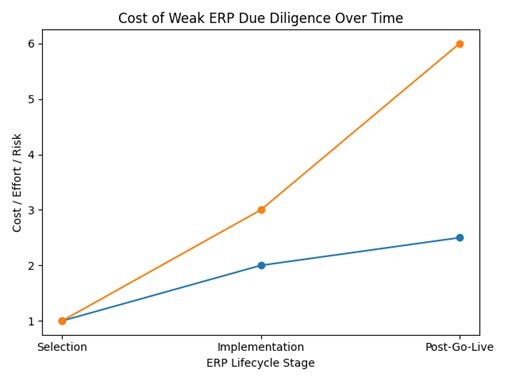
Cost of ERP due diligence over time: weak due diligence (orange) drives compounding cost and risk, while strong due diligence (blue) leads to more stable, predictable outcomes.
Who should be involved in ERP due diligence — IT, finance, or operations?
Effective ERP due diligence is inherently cross-functional.
It cannot be owned by IT alone, delegated entirely to a partner, or validated by finance in isolation.
What leadership teams should validate
Before making a final decision, leadership teams should be able to clearly explain how financial decisions will be made, how processes will be standardized, and how governance will be enforced.
If those answers are unclear, the system is not ready to be selected.
Ownership and accountability
When ownership is fragmented, problems follow a predictable pattern:
- Finance assumes IT owns system decisions.
- IT assumes the implementation partner defines structure.
- The partner executes based on available input, often without full visibility into business priorities.
The result is a system that reflects partial alignment rather than a unified operating model.
This is where a defined ERP governance framework becomes critical. It ensures that decisions are intentional, aligned, and sustainable over time.
Ryan’s Rule
The simplest way to think about ERP due diligence is this:
Never trade diligence for speed.
Speed can create momentum during selection. It can reduce the time it takes to move forward. But ERP decisions are not easily reversed.
Once the system is configured, it begins to reinforce the assumptions it was built on.
If those assumptions are incomplete, the system will reflect that incompleteness every day it is used.
Bottom line: ERP success is not determined by how quickly a decision is made. It is determined by how well that decision holds up over time, and whether the discipline of ERP due diligence was applied before the decision was finalized.
Key questions leadership teams should be asking
At this stage, the goal is not more software comparison. It’s making sure leadership is asking the questions that expose risk before it becomes embedded in the system:
- What are the risks of selecting ERP software without proper due diligence?
- Misaligned financial controls create audit exposure
- Weak governance distorts margin
- Poor planning increases long-term cost
- How do you conduct ERP due diligence before making a final decision?
- Perform structured ERP risk assessment
- Define financial decision rights
- Validate partner capability
- Who should be involved in ERP due diligence—IT, finance, or operations?
- Finance, operations, and leadership must align
- Operations validates processes
- Leadership ensures alignment
- Why do ERP problems often show up after go-live instead of during selection?
- Demos validate functionality, not structure
- Assumptions go untested
- Weak diligence creates long-term issues
What this series makes clear about ERP success
Across this series, one theme remains consistent:
ERP is not just a technology decision. It is a business decision with long-term financial consequences.
The first article established that ERP should be evaluated as a capital investment. The second showed how rushed decisions create avoidable cost and complexity.
This final article reinforces where those outcomes are determined.
Not during implementation. Not after go-live. But during the decisions leaders make before committing to a system.
This is where ERP due diligence becomes critical.
Because ERP systems don’t fail due to lack of capability.
They fail due to decisions that were never fully validated. And those decisions shape how the business operates long after the selection process is complete.
If your organization is evaluating ERP systems, the most valuable step is not comparing more software, it’s validating the decisions behind the selection.
We work with leadership teams to assess ERP risk, align financial and operational structure, and ensure those decisions hold up under real operating conditions.
If you want a clear view of where risk may already be forming in your evaluation process, let’s have a conversation.