
Most ERP cost overruns are self-inflicted.
Not intentionally, of course.
I've never met a leadership team that walked into a project kickoff and said, "Let's spend more than we planned and take longer than expected."
What I see more often is something much more common.
The project starts with good intentions. A few weeks later, someone says, "While we're doing this, could we also add..."
Then someone else remembers a report they've always wanted. A department requests a custom workflow. An old process that nobody questioned during planning suddenly becomes non-negotiable.
Individually, none of those decisions seem particularly expensive. But together, they can quietly increase ERP implementation cost.
Collectively, they reflect the financial discipline of a teenager with their first credit card.
The first two articles in this series focused on a simple idea: successful ERP migrations begin long before implementation starts. Both pointed to the same lesson: preparation matters.
That same principle applies whether an organization is evaluating the benefits of SAP Business One or preparing for any major ERP initiative. The software itself is only part of the equation. The decisions surrounding scope, governance, and change often have a greater impact on long-term outcomes than any individual feature or functionality.
Because most ERP budgets don't fail all at once. They drift. A change here. A customization there. A delayed decision that becomes an urgent decision later.
As a former transaction-services advisor, I've spent much of my career evaluating business assumptions and identifying risks before they become expensive surprises. ERP projects deserve the same level of scrutiny. The organizations that maintain control over budget and timelines aren't necessarily the ones with the largest teams or the biggest technology budgets. They're usually the ones with the clearest boundaries, the strongest governance, and the discipline to separate what is necessary from what is merely desirable.
In this final article, I'll look at how scope, governance, and change control help organizations avoid the cost surprises that derail otherwise promising ERP initiatives.
Why do ERP implementations go over budget?
Most leaders assume ERP cost overruns are caused by major unforeseen events.
In reality, they're usually caused by a series of smaller decisions that accumulate over the course of the project.
I've reviewed enough implementations over the years to tell you that budgets rarely fail because of a single catastrophic mistake. More often, they fail because important questions were never fully answered at the beginning.
- What exactly is in scope?
- Which processes will follow standard ERP functionality?
- What qualifies as a customization?
- Who has authority to approve changes?
- How will budget impacts be evaluated?
When those questions remain unresolved, costs begin to move in ways that are tough to predict.
One of the biggest contributors to ERP implementation risks is undefined requirements. Teams often know they need a new system, but they haven't fully documented how key processes should work in the future. That uncertainty creates gaps, and those gaps tend to surface after implementation work has already begun.
Another common issue is late customization requests.
A process that seemed straightforward during planning suddenly becomes more complicated when users begin reviewing workflows or participating in testing. Someone realizes a report is missing. Another team identifies an approval process that wasn't documented. A spreadsheet that's been quietly supporting operations for years suddenly becomes business critical.
None of those discoveries are unusual. The problem is that they occur after budgets and timelines have already been established.
Data readiness can also contribute to budget expansion. As I discussed in the previous article, organizations often underestimate the effort required to clean, validate, and govern information before migration. By the time those issues become visible, project resources have often been committed elsewhere.
And then there’s change control—or the lack of it.
Without a formal process for evaluating requests, projects become vulnerable to continuous expansion. Each change may seem reasonable on its own, but collectively they increase effort, complexity, testing requirements, and ultimately ERP implementation cost.
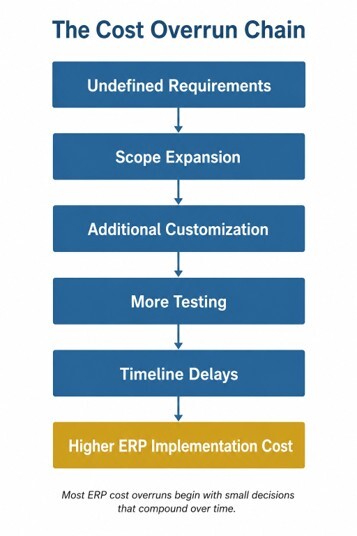
Many of these issues are visible long before they become expensive.
During transaction due diligence, one of the fastest ways to lose confidence in a forecast is discovering that key assumptions were never documented. ERP projects behave much the same way. When assumptions remain hidden, budgets become increasingly difficult to manage because nobody is working from the same understanding of success.
It’s not that every surprise can be prevented.
The lesson is that most surprises become a lot less expensive when they're identified early.
Standard vs. custom: controlling ERP implementation cost early
One of the fastest ways to increase ERP implementation cost is to postpone decisions about customization.
That may sound counterintuitive at first. After all, most organizations aren't trying to customize everything. They're just trying to make sure the new system supports the way they operate.
The challenge is that not every business preference is a business requirement.
That's a critical distinction.
I've found that leadership teams usually excel at identifying what makes their business unique. But if you ask which processes truly create competitive advantage and which ones simply reflect how things have always been done, that's often a much tougher question.
Those are not the same thing.
When organizations begin evaluating requirements, one of the most useful questions to ask is:
"Does this process need to be preserved, or does it need to be improved?"
The answer often determines whether a customization is necessary at all.
What qualifies as customization?
Not every configuration decision is a customization.
Adjusting user roles, approval thresholds, reporting layouts, and workflow settings are common implementation activities. True customization typically involves modifying system behavior, creating custom functionality, developing unique integrations, or building processes beyond standard ERP capabilities.
That distinction matters because customization affects far more than the initial implementation. It also influences testing, documentation, training, future upgrades, and long-term support.
What should adapt to the system?
This is where struggles often begin.
ERP projects create an opportunity to challenge long-standing assumptions.
I remember one executive who was adamant that a particular approval process had to remain exactly as it existed in the legacy system.
When the team stepped back and examined the business objective, they realized the approval itself was important... but the process surrounding it wasn't. The ERP system could achieve the same outcome with fewer steps and greater visibility.
The requirement was valid.
The workflow wasn't.
Standard functionality often addresses many business objectives. Adapting to proven processes can reduce complexity, accelerate implementation, and lower long-term support costs.
What creates long-term technical debt?
Every customization becomes something the organization owns.
It must be maintained. Tested. Supported. Documented. Evaluated during upgrades. And eventually, justified again when someone asks whether it's still needed.
That's why I encourage leadership teams to evaluate customization decisions through a business lens rather than a technical one.
Does the customization generate measurable value? Support a process that genuinely differentiates the business? Does it improve control, efficiency, customer experience, or reporting?
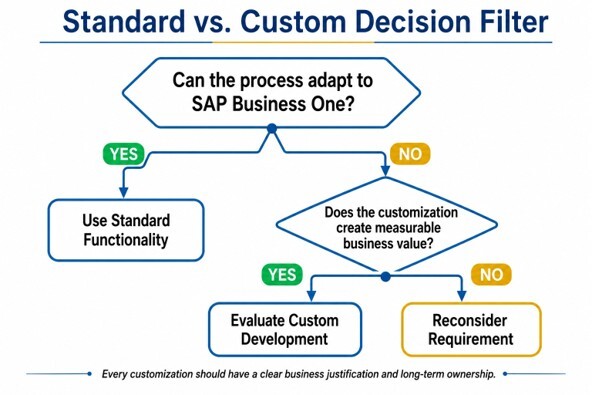
Upgrade risk is part of the equation
One factor that often gets overlooked during planning is upgrade impact.
The real cost of a customization isn't always visible during implementation. It often shows up later when the business wants to grow, integrate new systems, or upgrade the platform.
I've seen companies work surprisingly hard to preserve custom functionality that nobody would choose to build again today.
The customization wasn't solving a business problem anymore—it was simply surviving because nobody wanted to revisit the decision.
That's one reason I believe customization discussions should involve executive leadership, not just technical teams.
The conversation shouldn't be limited to whether something can be built. The more important question is whether it should be built.
Executive Perspective
Technical debt rarely arrives with a warning label. Every customization should solve a meaningful business problem, not preserve a habit.
Governance and change control
If customization decisions define the boundaries of a project, governance determines whether those boundaries hold.
At the start of an ERP project, everyone is aligned around a defined scope, timeline, and budget. Then implementation begins. New information emerges. Departments identify additional requirements. Priorities shift.
That’s all pretty standard.
The question is whether the organization has a process for evaluating those changes before they affect cost and timelines.
That's where ERP project governance becomes critical.
Good governance isn't about creating bureaucracy. It's about ensuring decisions are made deliberately rather than reactively.
Strong governance starts with executive sponsorship. Someone needs to own the outcome and help resolve competing priorities when requests inevitably arise.
What is change control in ERP projects and why does it matter?
The term "change control" sometimes creates the wrong impression.
People hear it and assume the goal is to prevent change.
It isn't.
Change is expected. In fact, some of the best ideas emerge after users begin testing workflows and understanding how the new system will operate.
A strong ERP change control process doesn't prevent those ideas from being considered. It simply ensures they're evaluated before commitments are made.
Every proposed change should answer four questions:
- Why is it needed?
- What business value does it create?
- What is the cost impact?
- What is the timeline impact?
I remember one client who jokingly referred to scope creep as "just-one-more-thing syndrome."
Every few weeks, another request surfaced. A report, a workflow adjustment, an integration that "shouldn't take too long."
Individually, none of the requests seemed unreasonable.
Collectively, they created a very different project than the one originally approved.
The requests weren’t bad ideas. But nobody was evaluating them together.
That's how ERP scope creep often happens... not through a single decision, but through dozens of small decisions that never appear significant on their own.
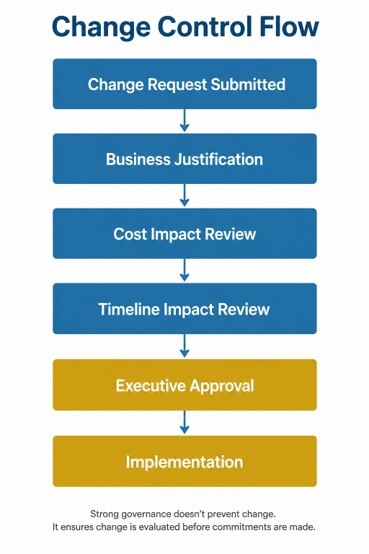
The organizations that manage ERP implementation cost most effectively aren't necessarily the ones that make the fewest changes.
They're the ones that understand the implications of those changes before approving them.
Because visibility is almost always less expensive than surprises.
Timeline realism: why speed often increases cost
Every leadership team wants an efficient implementation.
The challenge is that efficiency and urgency are not the same thing.
One of the most common misconceptions in ERP projects is that an aggressive timeline automatically reduces cost. In reality, compressed schedules often increase both risk and expense.
Testing is a good example:
When timelines become constrained, testing is often one of the first activities to be shortened. The problem is that testing doesn't eliminate issues—it exposes them.
Less testing simply means more problems are discovered later, when corrections are typically more disruptive and expensive.
The same principle applies to training, validation, and decision-making.
I've seen projects delayed not because the implementation team wasn't ready, but because key business resources weren't available when decisions needed to be made. Subject matter experts still have day jobs. Finance teams still have month-end closes. Operations teams still have customers to serve.
Those realities don't disappear because a project plan says otherwise.
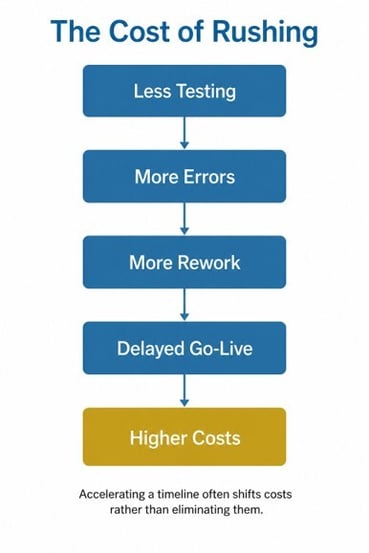
This is why realistic planning matters.
A well-structured timeline creates space for testing, validation, training, and thoughtful decision-making. An overly aggressive timeline often creates the opposite: more rework, more uncertainty, and greater pressure to make decisions without complete information.
Compressed schedules don't eliminate work.
They simply eliminate time.
How do you control ERP project scope and avoid scope creep?
The simplest answer is also the least exciting: Define more before implementation begins.
Most ERP scope creep isn't the result of poor intentions. It's the result of unanswered questions.
When requirements remain vague, teams fill in the gaps as the project progresses. New requests emerge. Assumptions get challenged. Priorities shift. Before long, the project may look very different than it did during planning.
That's why scope control must start long before configuration begins.
Organizations that manage ERP implementation costs effectively tend to have a few things in common:
- Scope is documented and approved in writing.
- Standard versus custom functionality is clearly defined.
- Decision-making authority is established early.
- Changes are evaluated through a formal review process.
- Milestones and deliverables are visible to leadership.
None of these eliminate change.
Business priorities evolve. New information becomes available. And sometimes a change genuinely improves the outcome.
The goal isn't to prevent change. It’s to ensure that every change is evaluated against its impact on budget, timeline, resources, and long-term support requirements.
In other words, treat every proposed change like an investment decision.
What's the expected return?
What's the cost?
What are we giving up in exchange?
It's a familiar framework for most CEOs, CFOs, and COOs. And it tends to produce better outcomes than making decisions based solely on urgency or convenience.
The organizations that avoid major ERP cost overruns aren't necessarily the ones that make fewer changes. They're the ones that make changes intentionally.
Because scope control isn't really about scope.
It's about discipline.
What should be finalized before starting an ERP implementation to avoid surprises?
By the time implementation begins, leadership doesn’t need all the answers.
But they should have clarity around the decisions that matter most, including:
- Project scope and priorities
- Customization criteria
- Governance and approval authority
- Budget assumptions and contingency planning
- Key milestones and resource commitments
Notice what's missing? Perfection.
ERP projects are complex, and some uncertainty is unavoidable. The goal isn't to eliminate every unknown, but to reduce the number of avoidable surprises.
Organizations define expectations, responsibilities, and decision-making processes upfront are far more likely to maintain control over both timeline and ERP implementation budget.
Because once implementation begins, clarity becomes significantly more expensive to create than it was during planning.
Most ERP implementation cost surprises aren't caused by software. They're caused by unclear requirements, uncontrolled change, weak governance, and decisions that remain unresolved for too long.
Organizations that define scope early, establish clear ownership, and evaluate change deliberately put themselves in a much stronger position to control cost, reduce risk, and achieve the outcomes they expect from their ERP investment.
Because in ERP, as in most business initiatives, clarity is usually far less expensive than surprise.
In case you missed the earlier articles in this series, here they are:
Together, these articles provide a practical framework for reducing risk throughout the ERP migration journey.
If your organization is planning an ERP migration, the best time to address scope, governance, and change-control challenges is before implementation begins.
At Clients First, we help organizations evaluate requirements, establish decision-making frameworks, and create practical implementation plans that reduce risk and improve long-term outcomes.
For a clearer view of where cost and complexity may be hiding in your ERP initiative, let's start with a conversation.