
An ERP Capital Investment is one of the few decisions you can make in a conference room that will quietly influence every transaction your company posts for the next five to ten years.
And yet, I still see ERP evaluated like it’s a new subscription tool: compared, demonstrated, scored, and selected based on how comfortable everyone feels at the end of a demo.
This is the first in a three-part executive series where I argue that ERP selection should be treated as a capital decision, not a demo-driven purchase. In the SAP Business One environments I guide, ERP directly affects financial controls and reporting reliability... which is exactly why it deserves board-level rigor.
I’ve been in enough ERP selection meetings to recognize the moment when the framing goes sideways:
The vendor finishes the demo. Order-to-cash looks smooth. Inventory transactions reconcile. The dashboard refreshes instantly. Someone says, “This is a lot cleaner than what we have now.” Someone else says, “Our team would pick this up quickly.”
Then the CFO leans back and asks the most reasonable — and most dangerous — question in ERP:
“So… are we comfortable moving forward?”
That’s usually when I get quiet.
Not because the system can’t do what was shown. Most SAP Business One demos are technically accurate. The workflows function. The reporting works. The integration points exist.
What concerns me is that the conversation often never pauses to ask how the system will enforce financial policy at the transaction level once it’s live.
ERP isn’t an app. It’s infrastructure. It’s poured concrete. When it’s wet, you can shape it, reinforce it, and make sure the foundation is level. Once it sets, you can still change it, but now you’re cutting into it with a jackhammer while the building is occupied.
And that’s the difference between buying software and underwriting an ERP Capital Investment.

What isn’t being discussed
Here’s the part that rarely gets said out loud in those rooms.
Everyone is tired of the current system. The team has lived through workarounds, reporting friction, and awkward upgrade cycles. There’s a natural desire to move forward. Momentum builds quickly once a vendor looks credible.
But I’ve learned to pay attention to what isn’t being discussed.
When no one can clearly articulate how reporting definitions will be standardized across branches…
When inventory valuation is described as “something we can refine later”…
When approval workflows are treated as a configuration detail instead of a governance statement…
That’s usually the moment I slow the room down.
Not to delay progress, but because ERP decisions don’t age neutrally. They compound. If governance is undefined when the system is configured, that ambiguity doesn’t disappear. It embeds itself into transaction flow.
And once it’s embedded, it shows up during month-end. Or audit. Or consolidation. Usually at exactly the wrong time.
That’s when leaders realize they approved a system but didn’t fully underwrite the operating model.
The boardroom conversation that determines the outcome
Let me walk you through a composite scenario I’ve seen more than once. It's a pattern that repeats across industries.
Mid-market company. Multiple branches. Growing revenue. Increasing reporting complexity. Leadership agrees the current system has outlived its usefulness.
The demo cycle begins.
Operations is focused on inventory visibility.
Finance wants cleaner margin reporting.
IT wants stability and upgrade safety.
The SAP Business One demo goes well.
- Sales orders flow cleanly into delivery and invoicing.
- Purchasing approvals are configurable by dollar amount.
- Inventory valuation can run FIFO or Moving Average.
- Multi-branch management appears straightforward.
- Reporting dashboards are customizable.
Everyone is engaged. Good questions are asked. The energy in the room is positive. Then someone asks, “What’s the realistic timeline to go live?”
And the conversation starts to compress.
Because once timeline pressure enters, architectural thinking often exits.
I’ve learned to insert a different set of questions right at that moment:
- “Who has defined what ‘good margin reporting’ means across all branches?”
- “Have we agreed on how cost centers will be standardized?”
- “Who owns changes to the chart of accounts once we’re live?”
- “Is inventory valuation a finance policy or an operational convenience?”
- “What happens when a branch manager wants to bypass an approval threshold?”
These aren’t academic questions. They are governance questions. And governance determines whether ERP stabilizes your operating model or quietly complicates it.
When those answers are vague, I know we’re evaluating software.
When those answers are defined, I know we’re evaluating capital.
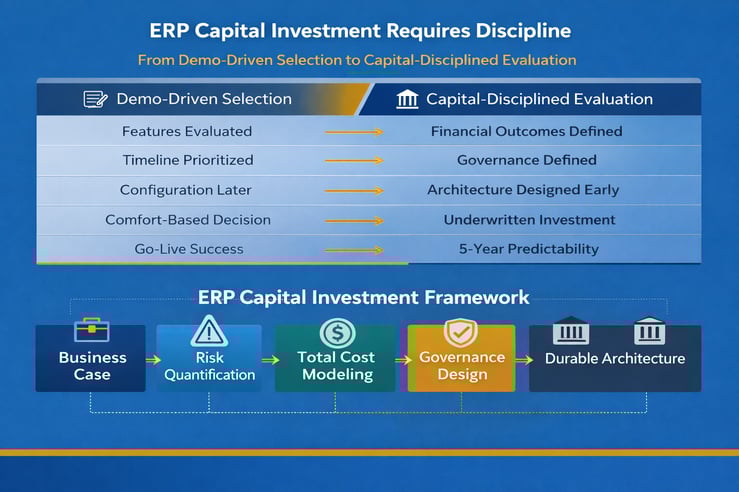
Purchase vs. investment: the framing error
Executive teams don’t intend to treat ERP casually. But framing drives behavior.
A purchase mindset focuses on:
- Feature comparison
- Licensing cost
- Implementation timeline
- Ease of use
An investment mindset focuses on:
- Long-term cost structure
- Risk exposure
- Control enforceability
- Reporting durability
- Upgrade safety
- Governance ownership
In SAP Business One specifically, decisions that feel small during configuration become structural commitments:
- Chart of accounts design defines reporting flexibility for years.
- Dimension strategy determines whether analytics are clean or constantly reconciled.
- Approval workflows either enforce discipline or create exception fatigue.
- Posting authorizations shape segregation-of-duties exposure.
- Inventory valuation method affects how margin is recognized and explained.
- Intercompany structure determines how painful consolidation will be.
These aren’t settings. They’re architecture.
And that’s why I insist ERP be evaluated as an ERP Capital Investment, not as a system replacement. A system replacement mindset optimizes for transition. A true ERP investment strategy optimizes for durability.
A deeper SAP Business One example: when architecture isn’t designed early
Let’s go deeper into an example that illustrates what I mean.
A manufacturing company adopts SAP Business One. The implementation team focuses heavily on operational functionality:
- Production structures calculate accurately
- Work orders post as expected
- Inventory updates in real time
- Inventory updates in real time
- Cost of goods sold flows cleanly to the general ledger
From a workflow standpoint, everything appears solid.
But during evaluation, several decisions were deferred:
- How standard costs would be governed across product lines.
- Who would approve cost roll-ups.
- How scrap would be reported consistently.
- Whether labor variance would be analyzed centrally or by branch.
- How overhead allocation logic would evolve as production scaled.
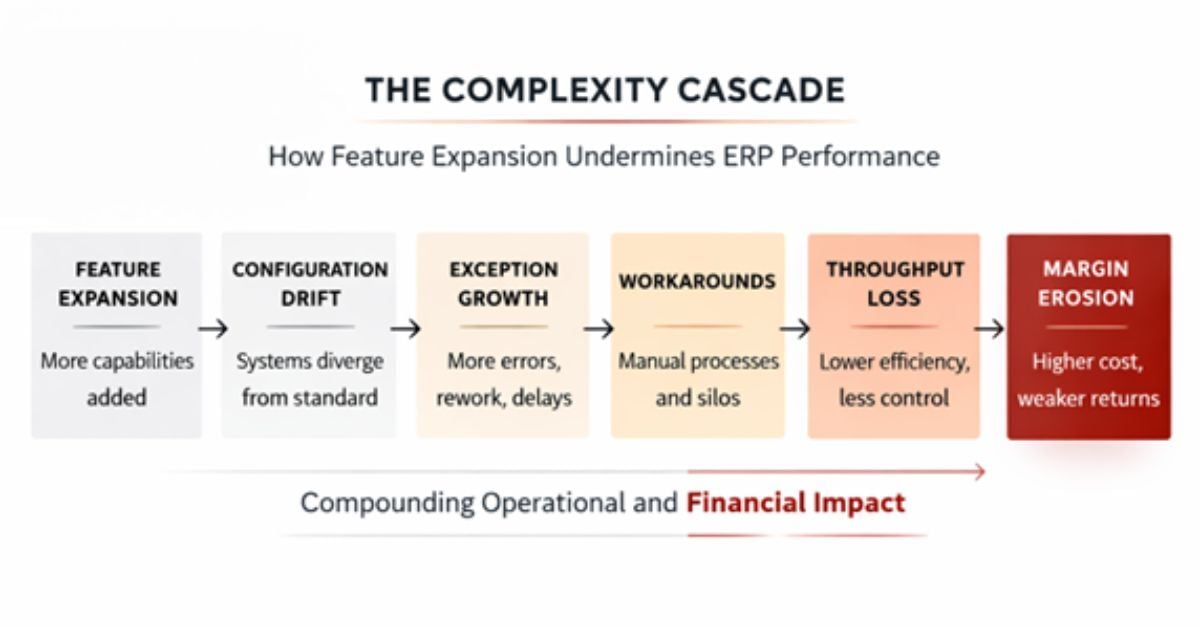
At go-live, the system performs. Three months later, production volume increases. Margin volatility appears. Nothing dramatic. Just enough to require explanation.
Finance begins building supplemental spreadsheets to interpret results. Adjustments become part of the monthly routine. Conversations start including phrases like, “That’s just how the system posts.”
The system is functioning exactly as configured.
The architecture wasn’t designed with long-term capital discipline.
This is where the poured concrete metaphor becomes real. When transaction-level financial logic sets, revisiting it isn’t a configuration tweak — it’s a redesign project.
That’s why an ERP Capital Investment demands upfront governance clarity.

When Architecture Diverges Across Branches
Now let’s look at a second composite example, but this time in a multi-branch environment.
The organization expands from one entity to three. Each branch operates with slightly different habits. During implementation, leadership agrees that “we’ll standardize reporting once we’re live.”
At go-live, everything technically works.
Each branch posts transactions correctly. Intercompany transactions can be entered. Consolidated financials can be produced.
But here’s what begins to drift over time:
- Branch A uses cost centers consistently.
- Branch B uses them occasionally.
- Branch C uses generic placeholders because “we didn’t have time to finalize structure.”
Approval thresholds vary slightly. Reporting groupings evolve independently. Item master governance isn’t centralized, so valuation logic differs subtly across branches.
None of this breaks the system.
But six months later, the CFO reviews consolidated margin and realizes something uncomfortable: the numbers are technically correct, but not meaningfully comparable.
Now finance is normalizing branch reports manually. Intercompany reconciliation requires explanation calls. Consolidation prep becomes an exercise in interpretation rather than reporting.
What happened?
Nothing dramatic. No failed implementation. No technical meltdown.
Architecture was allowed to diverge because governance wasn’t fully designed when the system was configured.
That’s the quiet cost of not treating ERP as infrastructure. Consolidation isn’t just a reporting activity — it’s a reflection of structural discipline.
And structural discipline must be designed early.
How should executive teams evaluate ERP like a capital investment instead of a software purchase?
If you were acquiring equipment, opening a new facility, or making an acquisition, you’d apply capital discipline. ERP deserves the same structure.
Here’s what that looks like in practice.
Build a Formal ERP Business Case
An ERP business case must go beyond modernization language. It defines whether you’re making a short-term purchase or committing to a durable ERP investment strategy built to hold up over a five-to-ten-year horizon.
It should answer:
- How will close-cycle reliability improve?
- What does “better margin visibility” mean in measurable terms?
- What working capital insights will be gained?
- What controls become enforceable by system design?
A disciplined business case doesn’t center on features. It ties the investment directly to measurable financial outcomes: margin, working capital, close efficiency, and risk containment. That’s the standard any capital decision should meet.
Without that clarity, you’re comparing features, not underwriting capital.
That’s the risk of skipping a formal ERP business case: the system may go live, but the financial logic underneath it was never fully underwritten.
Quantify ERP Implementation Risk Beyond Schedule
Most teams model timeline risk. Fewer model structural risk.
In SAP Business One environments, ERP implementation risk includes:
- Misaligned chart-of-accounts structure
- Inconsistent dimension usage across branches
- Weak master data governance
- Unclear approval authority
- Intercompany posting drift
- Customizations that undermine upgrade safety
Digital transformations rarely fail because of software. They fail when governance slips and execution discipline erodes. That’s the core of ERP implementation risk: not technical failure, but structural ambiguity that compounds over time.
What are the hidden costs of an ERP implementation that CFOs often underestimate?
Model ERP Total Cost of Ownership Over Five Years
ERP total cost of ownership isn’t just licensing and implementation.
It includes:
- Reporting redefinition
- Control redesign
- Upgrade remediation
- Customization maintenance
- Partner dependence
- Manual reconciliation effort that becomes normalized
Capital discipline doesn’t eliminate cost. It eliminates surprise. And disciplined modeling of ERP total cost of ownership is what prevents small architectural shortcuts from turning into recurring financial friction.
Define the ERP Governance Model Before Configuration
An effective ERP governance model should clarify:
- Who owns master data.
- Who approves changes to valuation methods.
- How approval workflows are structured and enforced.
- How posting authorizations align with segregation of duties.
- How intercompany postings are standardized.
- How reporting definitions are controlled.
If governance is undefined at go-live, it will be defined under pressure. That’s rarely efficient. A defined ERP governance model ensures policy is embedded before pressure tests it.
Is ERP considered a capital expense (CapEx) or an operating expense (OpEx)?
From an accounting perspective, implementation costs often qualify for capitalization because they create long-term operational infrastructure.
PwC provides useful guidance on accounting for cloud computing arrangements:
But accounting classification, while important, doesn’t fully capture the strategic impact.
That’s why I approach ERP as an ERP Capital Investment in substance, not just in terminology. Because once the architecture is live, it shapes financial predictability long after the implementation project is complete.
The five-year contrast: two paths
I often ask executive teams to consider two parallel futures.
Scenario A: Demo-Led Selection
- Governance decisions are deferred.
- Reporting definitions evolve reactively.
- Close is manageable but not predictable.
- Upgrade projects are tense.
- Finance builds workarounds.
Scenario B: Capital-Disciplined Selection
- Governance is drafted before the build.
- Reporting structure is agreed early.
- Approval thresholds reflect real authority.
- Upgrade-safe design is intentional.
- Close becomes predictable because the architecture supports it.
The system in both cases could be SAP Business One.
But there’s another subtle pattern that tends to emerge in Scenario A environments... approval erosion. At go-live, approval thresholds are defined. Posting authorizations are set. Controls feel intentional.
Then real life starts:
“It’s just a small exception.”
“We can override this one.”
“That threshold is slowing us down.”
Individually, each exception feels harmless. Collectively, they reshape governance.
Five years later, Scenario A organizations often have reporting that works, but control that depends on vigilance instead of structure. Month-end feels less like a process and more like a confirmation exercise: Did everything behave the way we hoped?
In Scenario B organizations, the tone is different. Close becomes procedural rather than investigative. Consolidation is predictable. Audit discussions are focused instead of defensive.
The system isn’t necessarily more powerful... It’s more intentional.
And that difference traces all the way back to how the ERP decision was framed at the beginning. As infrastructure, or as procurement.
Executive accountability: where discipline lives
ERP projects often start in IT. Capital decisions live in the executive suite.
Transaction-level architecture decisions belong to finance and operations leadership:
- Who defines performance metrics?
- Who governs valuation policy?
- Who enforces approval authority?
- Who owns reporting definitions?
- Who decides when structural changes are allowed?
If those decisions are unclear, ERP is being installed.
If those decisions are defined, ERP is being invested in.
Capital discipline in practice
Capital discipline in ERP selection means:
- Slowing down long enough to design architecture intentionally.
- Modeling risk beyond the implementation timeline.
- Aligning SAP Business One structure to financial strategy.
- Designing for upgrade durability.
- Treating governance as structural, not optional.
ERP decisions are rarely reversed. They’re adjusted. And adjustments cost more than design.
That’s why I approach ERP with board-level rigor and multi-year thinking. Once the concrete sets, the organization lives on it.
In the next article, I’ll examine what executive teams commonly miss during ERP evaluations — the blind spots that compound over time. Then to wrap up this series, I’ll address the material risk created when due diligence is reduced to feature comparison.
Because the most expensive ERP decision isn’t the one with the highest licensing cost. It’s the one that wasn’t underwritten properly.
If you’re evaluating SAP Business One, or reassessing whether your current environment is structured for long-term control and predictability, let's talk.