
At what point does a system designed to support operations start making the work harder instead of easier?
In conversations I’ve had with manufacturing leaders over the years, that question often leads to a comparison I hear surprisingly often: ERP systems are a lot like work trucks.
When you first buy one, it’s exactly what the job requires. It hauls what you need, handles the terrain, and makes the day-to-day work easier.
But over time, things change.
Maybe the business grows. Maybe the equipment evolves. Sometimes the truck itself becomes heavier and more complicated than the job actually requires.
I’ve seen the same thing happen with ERP systems.
In many of those conversations, leaders evaluating an Epicor alternative for small manufacturers, often running Epicor Kinetic (formerly Epicor ERP), aren’t looking for the most complicated technology available. They’re asking a simpler question: does the system reliably support the work that needs to get done?
When an ERP system starts creating more work than it removes, that’s usually when the evaluation conversation begins.
For some manufacturers, Epicor has served the business well for years. But as the system evolves — and as vendor strategies shift — some organizations begin to ask a practical question: is this still the right fit for how we operate today?
That’s often when leaders begin evaluating their ERP options.
Not because Epicor is a bad system... it's been a dependable workhorse for manufacturers for years. But smaller manufacturing companies often need ERP platforms that match their operational scale — supporting production, inventory, and financial management without introducing unnecessary complexity.
In many of those discussions, the conversation shifts from maintaining the existing system to asking a more practical question: is it time to consider an Epicor alternative, and could SAP Business One be a better fit?
Many manufacturers researching an Epicor alternative are not necessarily replacing a failed system. Instead, they are evaluating whether a different ERP architecture might better support the operational scale and growth trajectory of their business.
Series Context
This article is the first in a three-part series exploring why some small and midsize manufacturers running Epicor begin evaluating alternative ERP platforms — and why SAP Business One often enters that conversation.
In the next post, I’ll examine how deployment flexibility — including cloud, on-premises, and hybrid models — influences those decisions. In the final article, I’ll walk through how organizations can transition from Epicor to SAP Business One in a structured, low-disruption way.
Why are some Epicor customers considering switching to SAP Business One?
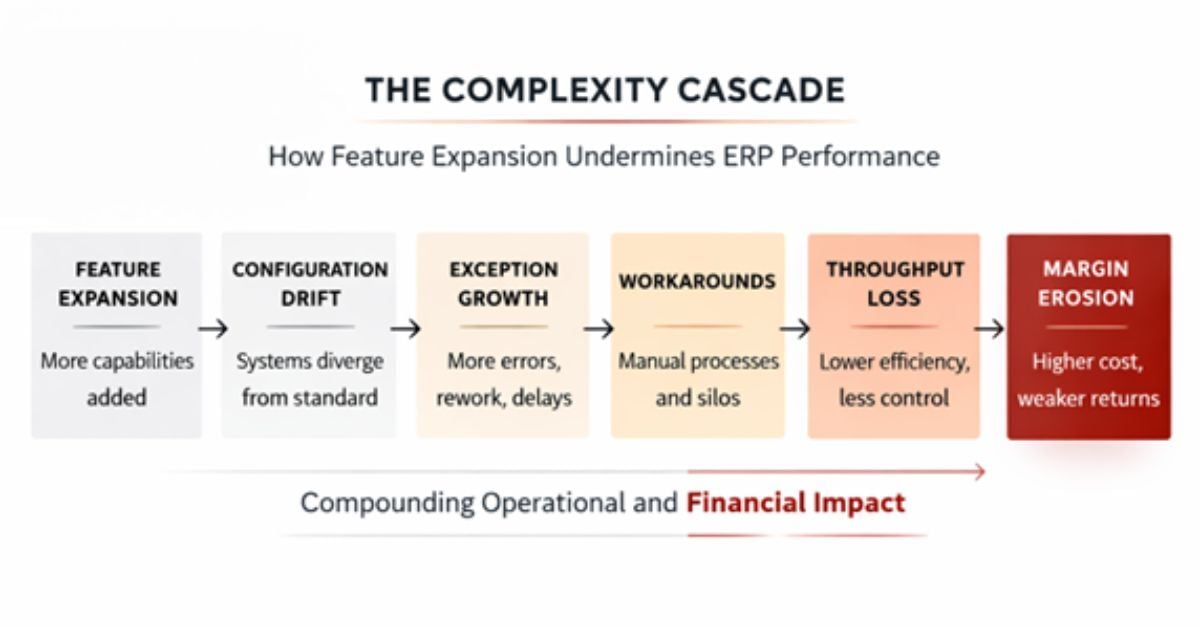

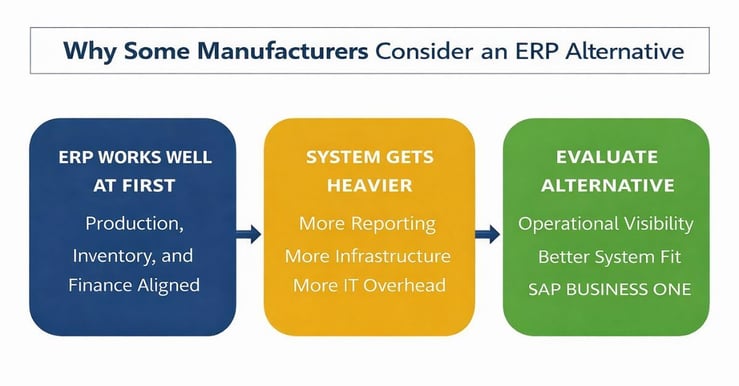
ERP systems are rarely replaced because they suddenly stop working.
More often, the conversation begins gradually.
- A leadership team starts noticing that routine changes require more effort than expected.
- Adding a new product configuration may require updates across multiple records or configuration layers within the ERP system.
- Reporting requests take longer to produce.
- Infrastructure decisions start appearing in conversations that were originally about operations.
Over time, a pattern emerges: the system still functions, but it feels heavier than the organization itself.
This is something I’ve seen in conversations with a number of small and midsize organizations running Epicor platforms such as Epicor Kinetic, and Epicor Prophet 21, for light manufacturing operations. In many cases the platform is performing exactly as designed.
The real question isn’t whether the software works. It's whether the system’s complexity and infrastructure expectations still match the scale of the business.
That distinction matters.
ERP platforms are designed to support very different operational environments. Some systems are built primarily for large enterprises managing multiple divisions, complex global supply chains, and extensive internal IT resources.
When those architectures operate inside a smaller manufacturing organization, they can introduce layers of infrastructure and process complexity that the business never originally required.
Independent ERP research frequently categorizes ERP platforms by operational tier, reflecting the size and complexity of the organizations they are designed to support.
According to Panorama Consulting Group’s ERP Report research, enterprise ERP systems are typically built to support large organizations with extensive operational complexity, while other platforms are designed specifically for small and midsize companies that require strong operational control without the same level of infrastructure overhead.
Understanding that distinction often becomes an important step for manufacturers evaluating whether their current system still aligns with the scale of their operations.
This is one reason some companies begin evaluating an Epicor alternative for small manufacturers. The goal is not necessarily to replace functionality, but to reassess whether the system aligns with how the organization actually operates today.
In many small and midsize manufacturing environments, leadership teams prioritize practical operational visibility: understanding production output, managing inventory levels, monitoring purchasing activity, and maintaining reliable financial reporting.
When the ERP environment becomes harder to manage, leadership teams begin questioning whether the system still supports the way the organization actually operates.
Research on midsize companies reinforces this broader shift. Many leadership teams are actively looking for ways to simplify operations while supporting growth, and technology decisions often play a central role in that effort.
So when companies begin evaluating alternatives, SAP Business One frequently appears in the conversation.
As a platform designed specifically for small and midsize organizations, it tends to align more closely with the operational realities of manufacturers operating at that scale.
This doesn’t mean Epicor is the wrong system for every company. But it does explain why some organizations begin asking whether a different architecture might better support the way their business operates today.
Is Epicor too complex for small manufacturers?
This question comes up frequently when leadership teams begin reviewing their ERP environment.
To be clear, Epicor is a capable system. It was designed to support complex manufacturing environments and can handle sophisticated operational requirements.
For companies operating across multiple divisions or managing highly complex production networks, that level of capability can be valuable.
But many smaller manufacturers operate under very different conditions.
In many cases, their production environments involve a limited number of product families, straightforward bills of material, and relatively predictable production cycles.
They still require strong operational control, but they often maintain smaller IT teams and more streamlined organizational structures.
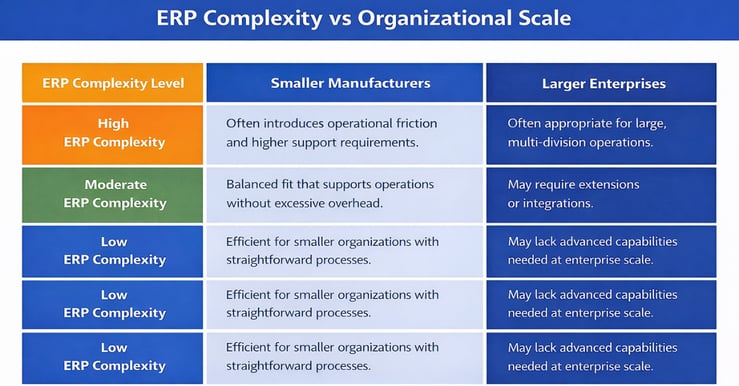
ERP systems perform best when their architecture aligns with the operational scale of the organization.
In those environments, ERP systems must strike a careful balance.
For example, introducing a new product configuration can sometimes reveal how tightly interconnected ERP data structures have become over time.
What initially appears to be a simple operational change, such as adding a new variation of an existing product, may require updates across multiple records, including part definitions, revisions, routing steps, and plant-level inventory settings.
When these changes involve several interconnected tables or configuration layers, even small adjustments can require coordination between operations, IT, and external consultants.
Situations like this do not necessarily indicate that the system is failing. Instead, they often highlight how the system architecture was originally designed for organizations operating at a larger scale.
What happens when ERP complexity meets a lean IT team?
Another practical consideration is the size of the internal IT team responsible for supporting the system.
Larger enterprises often maintain dedicated ERP specialists, infrastructure teams, and internal developers.
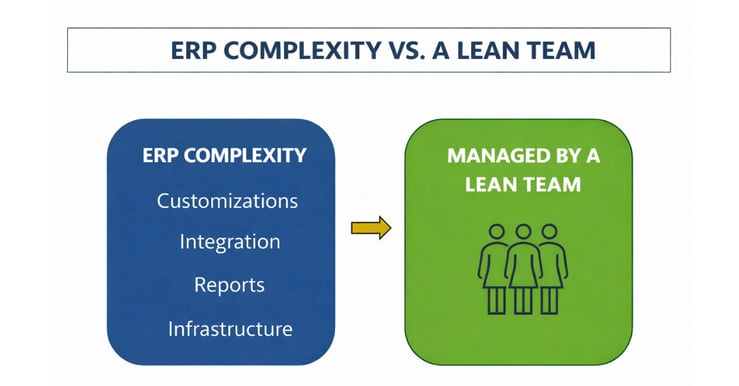
Smaller manufacturers typically operate with leaner technology resources, where a small group of employees may manage ERP alongside many other operational responsibilities.
When a system requires significant customization, management, or infrastructure oversight, it can place additional pressure on those limited resources.
Over time, ERP environments often accumulate customizations, integrations, and process workarounds that were originally introduced to solve specific operational challenges.
While each change may have been justified at the time, the combined result can gradually increase system complexity and make upgrades, reporting, or process adjustments more difficult.
Another common situation emerges during system upgrades. As ERP environments evolve, the customizations and integrations built over time may need to be reviewed, tested, or rewritten to ensure compatibility with new versions of the platform.
For organizations with limited internal IT resources, that process can require additional planning and outside expertise.
Industry observers have noted this trend as well. Forbes notes that many organizations are now reevaluating how much customization their ERP systems require and whether those modifications ultimately create more long-term complexity than value.
For companies exploring an Epicor alternative for small manufacturers, the goal is rarely to eliminate functionality. Instead, it is to determine whether a system with a different architecture might deliver the same operational insight while remaining easier to manage over time.
What ERP systems are alternatives to Epicor for small manufacturers?
Once manufacturers begin exploring alternatives, the discussion often shifts from identifying problems to identifying operational priorities.
Manufacturers evaluating alternatives to Epicor typically encounter several platforms during the research process. Solutions such as Microsoft Dynamics Business Central, NetSuite, Acumatica, and SAP Business One are frequently considered by organizations looking for ERP systems designed for small and midsize operations.
Each platform approaches the midmarket ERP challenge differently. Some emphasize cloud-native architecture and subscription deployment models. Others focus on industry flexibility or strong integration within broader business software ecosystems.
Key Questions Manufacturers Ask When Evaluating ERP Alternatives
|
Evaluation Area |
Key Question |
|
Operational Visibility |
Can leadership easily access production, inventory, purchasing, and financial data? |
|
System Manageability |
How difficult are upgrades, updates, and ongoing system maintenance? |
|
Infrastructure Requirements |
What internal IT resources are required to support the system? |
|
Process Alignment |
Does the ERP system match the way the business actually operates? |
|
Scalability |
Will the system continue to support the organization as it grows? |
What should manufacturers look for in an Epicor alternative for small manufacturers?
For many small and midsize manufacturers, the answer centers on three areas: operational insight, financial control, and system manageability.
Leaders want reliable insight into production activity, inventory levels, purchasing commitments, and financial performance without requiring extensive technical infrastructure to maintain those capabilities.
Reporting often becomes an important indicator.
Leadership teams may need to review production output by product line, track inventory levels across warehouses, or evaluate profitability by customer.
When generating those reports requires complex queries, custom report development, or manual data consolidation from multiple modules, leaders may begin questioning whether the system architecture still aligns with the way the business operates.
This is where SAP Business One frequently enters the evaluation process.
Unlike enterprise-scale ERP platforms designed primarily for global organizations, SAP Business One was built specifically for small and midsize companies. The system integrates financial management, inventory control, purchasing, production processes, and reporting within a single platform designed to remain manageable for organizations without large internal IT teams.
Real-world examples illustrate how that alignment works in practice. For example, Translectric, a manufacturer/distributor, achieved 10% revenue growth after implementing SAP B1 with the expert guidance of Clients First.
They reduced costs by unifying operations under one integrated business solution. Continuous access to crucial data allows them to build and sell the right products at the right time, quicker.
"Choosing the right partner is critical to the success of SAP Business one. Clients First’s level of knowledge and willingness to share it showed us that no matter what your level of experience is with SAP, you can learn it to enable better business decisions." Ruth Niswonger, CEO Translectric
When companies begin comparing Epicor vs SAP Business One, the evaluation usually focuses on practical operational questions.
- How much infrastructure is required to maintain the system?
- How easily can operational reports be generated?
- How complex are system updates and upgrades over time?
- Does the system architecture align with the company’s operational scale?
These questions reflect a broader shift in how many manufacturers approach ERP decisions. Rather than focusing solely on feature lists, organizations increasingly prioritize systems that match the size and structure of their operations.
As a result, some companies evaluating an Epicor alternative for small manufacturers ultimately include SAP Business One in their assessment.
The platform often provides the manufacturing and financial functionality these organizations require while remaining aligned with the operational realities of small and midsize companies.
Operational alignment matters more than vendor reputation
One of the most common misconceptions about ERP selection is that the decision should be based primarily on vendor reputation or the number of available features.
In practice, those factors rarely determine whether a system ultimately succeeds inside an organization.
ERP platforms function as operational infrastructure inside the business. They influence how production data flows through the business, how financial reporting is generated, and how leadership teams monitor operational performance.
Because of that, the architecture of the system can have long-term implications for operational efficiency and decision-making.
As technology continues evolving, ERP systems are also becoming increasingly connected to broader digital initiatives. Automation, analytics, and AI-driven insights all depend on data managed inside the ERP environment.
Research from McKinsey highlights how modern ERP environments are becoming foundational platforms that connect operational data with broader automation and analytics initiatives across the enterprise.
How easily can your ERP data move across the business?
Another factor leadership teams increasingly consider is how easily operational data can move across the organization.
Production planning, inventory management, purchasing, and financial reporting rarely operate in isolation. When information flows smoothly between these areas, leaders gain a clearer view of operational performance and can respond more quickly to changing demand or supply conditions.
When data becomes fragmented or difficult to access, however, even well-designed processes can become harder to manage. Teams spend more time reconciling reports, coordinating information across departments, or manually verifying data before making decisions.
ERP architecture plays a significant role in determining how efficiently that information moves through the business. Systems that align well with the scale and structure of the organization often make it easier for leaders to maintain consistent visibility across operations.
For smaller manufacturers, this reinforces the importance of choosing a system that aligns with their operational scale and internal capabilities.
A well-aligned ERP system can support improved visibility, more reliable reporting, and better coordination across departments.
A poorly aligned system, even if technically capable, can gradually introduce operational friction.
That’s why the most effective ERP evaluations focus less on vendor comparison and more on operational fit.
Leadership teams evaluating alternatives are ultimately asking a practical question: which system best supports the way our organization actually operates?
Conclusion
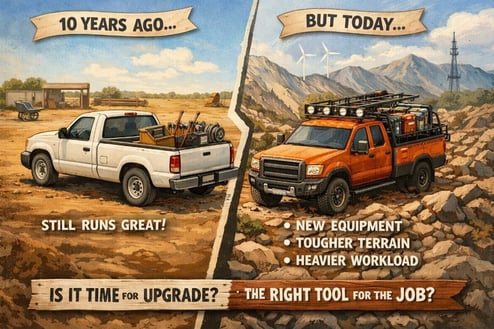
That brings us back to the work truck analogy.
A truck that was perfect for the job ten years ago may not necessarily match the way the work is done today. The vehicle itself may still run perfectly well, but changes in equipment, terrain, or workload can eventually make it worth reconsidering whether a different tool would better support the task.
ERP decisions often follow the same pattern.
For many manufacturers running Epicor, the system continues to function exactly as intended. But as business needs evolve, leadership teams sometimes begin reevaluating whether the system’s architecture, complexity, and infrastructure requirements still match the scale of their organization.
That’s when companies begin exploring an Epicor alternative — not because the existing platform has failed, but because they want to ensure their operational systems remain aligned with the way the business actually runs.
In most cases, these conversations don’t start with complaints. They start with curiosity — leadership teams asking whether the tools supporting the business today will still support where the company is going next.
My next article in this series will explore another factor that increasingly influences ERP decisions: deployment flexibility.
For many manufacturers evaluating alternatives, the ability to choose between cloud, on-premises, or hybrid environments plays a major role in determining which platform best supports long-term operational control.
If your system feels heavier than the work it supports, it may be time for a structured evaluation. We help manufacturers assess ERP fit based on operational realities—not vendor demos. Schedule an ERP Fit Assessment.