Syspro Alternatives: What Manufacturers Should Know
Quick answer: Syspro is discontinuing its Annual License Fee model and moving to subscription-only licensing for both new and existing customers.
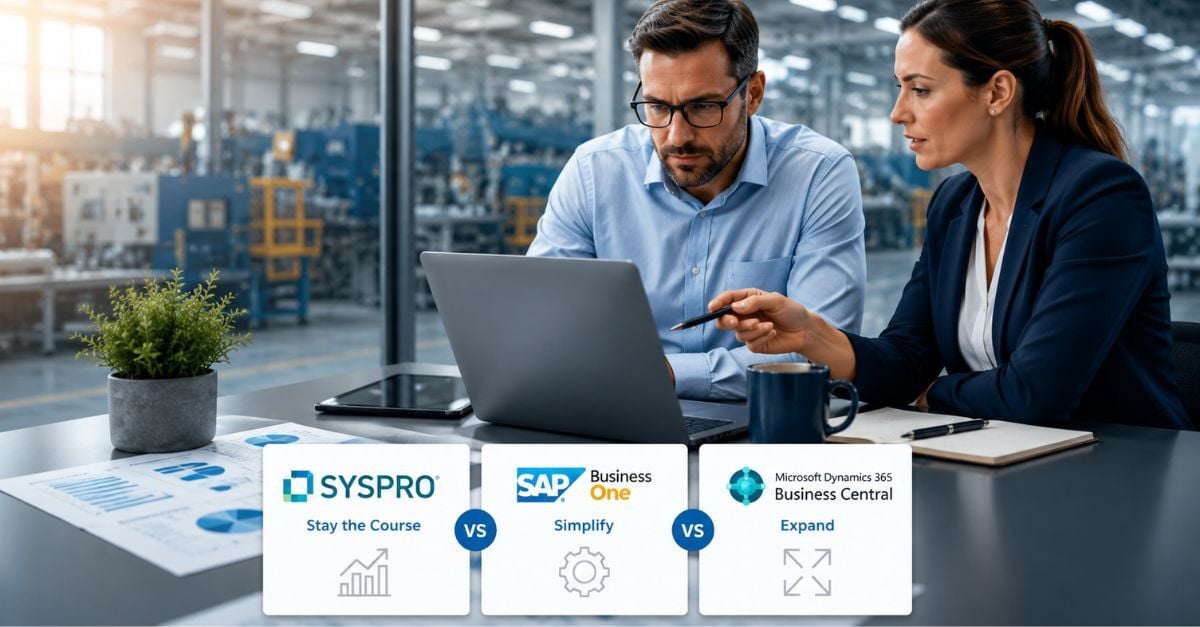
Manufacturers considering Syspro alternatives as a result generally fall into two groups: those who aren’t using everything they're paying for and want to simplify onto a leaner platform like SAP Business One, and those who are unhappy with the new cost structure and want to put that spend toward a more scalable platform like Microsoft Dynamics 365 Business Central.
Every ERP conversation I have with a manufacturer eventually arrives at the same question: is this system still serving the business, or has the business quietly started serving the system?
For a long time, Syspro customers had little reason to revisit that question. The software worked, the cost was predictable, and there was no deadline forcing a decision.
That's changed.
Syspro has announced it's retiring Annual License Fees entirely.
Existing customers will need to enter a new subscription agreement when their current license term expires, and going forward, subscription is the only option on the table for new and existing customers alike.
That's not a small licensing footnote.
For manufacturers who built their budgets around a perpetual, on-premises cost structure, it's a real shift in how Syspro is licensed and what it may cost going forward, and it's arriving with a deadline attached rather than as an optional upgrade.
So we're hearing from a lot of Syspro customers considering Syspro alternatives right now, and many fall into one of two groups.
Two Kinds of Syspro Customers We're Hearing From
Group 1: "We were never using most of it anyway."
These are businesses that implemented Syspro years ago, often for a broader manufacturing operation than they run today, or with more modules than they ever fully adopted. Reporting is handled in spreadsheets.
Half the modules are dormant.
The team has built workarounds for the parts of the system nobody wants to touch.
For this group, the licensing change isn't a reason to find a comparable replacement; it's a reason to ask why they're paying for capability they don't use at all.
Group 2: "We're already paying more, so let's get more for it."
The second group isn't necessarily overpaying for unused functionality.
They're frustrated by the pricing change itself, and by the timing of it, but they also see it as a reason to reevaluate their options.
If the cost of standing still just went up, several leaders have told us they'd rather put that budget toward a platform that gives them room to grow: better reporting, tighter integration with the rest of the business, and a clearer path to scale, rather than just re-signing for the same thing at a higher price.
Neither response is wrong. They're just different starting points for evaluating Syspro alternatives, and they point toward different platforms.
Where SAP Business One Fits: The Simplify Path
For manufacturers in the first group, SAP Business One is worth a close look.
It's built to be scoped tightly around the manufacturing, financial, and inventory functions a business actually uses day to day, without the overhead of modules that were sized for a different version of the company.
The goal on this path isn't to find something smaller for its own sake. It's to stop paying for complexity that isn't earning its keep, while still keeping core manufacturing capabilities such as BOM, MRP, and production tracking that made Syspro a reasonable fit in the first place.
We go deeper on Syspro vs SAP Business One in this scenario, including how to tell whether you've genuinely outgrown Syspro's complexity or just never grown into it.
Where Business Central Fits: The Expand Path
For manufacturers facing higher costs under the new licensing model, several leaders have decided that spend is better directed toward a platform with more room to grow: tighter integration with the Microsoft tools most teams already use, a broader partner and app ecosystem, and a clearer runway as the business adds users, locations, or complexity.
This path isn't about replacing one ERP with a bigger one for its own sake; it's about making sure that if costs are increasing, the business gets something more for that investment.
We cover the Syspro vs Business Central comparison in more detail in the next blog in this series.
Comparing Syspro ERP Alternatives: SAP Business One and Business Central
|
|
Syspro (subscription) |
SAP Business One |
Business Central |
|
Licensing model |
Subscription-only, named user |
Perpetual or subscription, flexible |
Subscription, tiered by user type |
|
Deployment |
Cloud-first, with on-premises deployment available |
Cloud, on-prem, or hybrid |
Cloud-first, with on-prem via partner hosting |
|
Core strength |
Discrete manufacturing depth |
Manufacturing + financials in a compact footprint |
Broad platform integration and scalability |
|
Best fit for |
Manufacturers comfortable with the new licensing model |
Simplifying an underused system |
Expanding capability and integration |
This is a starting point, not a full evaluation of ERP alternatives for manufacturers.
The right choice among Syspro alternatives depends on your current module mix, user count, and where you actually feel friction today, which is exactly what a proper discovery conversation is for.
Frequently Asked Questions About Syspro Alternatives
Why is Syspro moving to subscription pricing?
Syspro is retiring its Annual License Fee model in favor of subscription-only licensing for all customers, new and existing.
The company frames it as a shift toward continuous product delivery and expanding AI capability, but for customers, it also means the perpetual on-premises cost structure many budgeted around is no longer available going forward.
Is SAP Business One a good alternative to Syspro?
SAP Business One is a strong option for manufacturers who've been paying for more Syspro functionality than they use. It covers core manufacturing, financial, and inventory needs, and it's a natural fit for businesses looking to simplify rather than expand.
Is Microsoft Business Central a good alternative to Syspro?
Business Central for manufacturing can be a strong fit for companies that want more capability and integration for their ERP spend, particularly those already invested in the Microsoft ecosystem. It's a common choice for businesses treating the licensing change as an opportunity to scale rather than just re-signing under the new model.
Do I have to switch ERP systems because of Syspro's licensing change?
No. Some manufacturers will decide the new subscription model is acceptable and stay put.
But the licensing change is a reasonable trigger to at least evaluate whether the system still fits, especially if you've never done that evaluation before or if your operation looks different than it did when Syspro was first implemented.
Where to Go from Here
If your team is facing Syspro's subscription conversion and evaluating manufacturing ERP alternatives, that's exactly the conversation we have with manufacturers every week.
Client's First works with both SAP Business One and Microsoft Dynamics 365 Business Central, so the recommendation starts with your operation, not with a product we're trying to sell.
In the next two posts in this series, we'll go deeper on each path: simplifying onto SAP Business One and expanding into Business Central, followed by a migration blueprint for each platform.
If you'd rather skip ahead, we're happy to talk through where your business fits first.