
Imagine trying to run a manufacturing business where every department speaks a different language.
Production has one version of the truth.
Shipping has another.
Accounting has a third.
And customer service is left translating between them.
It sounds absurd—until you realize many businesses have unintentionally created that exact situation with their software.
Today's manufacturers and distributors rely on far more than a single ERP system. Warehouse management, shipping platforms, CRM, eCommerce, reporting tools, and other business applications all play an important role.
But when those systems aren't designed to communicate reliably, information becomes inconsistent, manual work increases, and operational problems inevitably follow.
Whether you're evaluating or already running SAP Business One, understanding ERP integration is becoming just as important as understanding the ERP itself. ERP doesn't need to replace every business application. It needs to connect to them in a way that's stable, secure, and built to support the business as it grows.
This article is the first in a three-part series exploring why ERP value comes from integration, not isolation. Here I'll explain what ERP integration really means, why it has become a business priority, and how stable ERP integration architecture supports a connected ERP ecosystem.
In the following articles, I'll explore why ERP integrations break and how to prevent them, then share a practical roadmap for deciding what to connect first.
What is a system of record?
A system of record is the authoritative source for critical business data, helping every connected application work from the same accurate information.
When business leaders talk about improving visibility, they often focus on dashboards, reports, or analytics. But those tools are only as reliable as the data behind them.
If different systems store different versions of the same information, even the best reporting can't provide a clear picture of what's happening across the business.
That's why every ERP strategy should begin with a simple question: Which system owns the data?
Whether the ERP system is SAP Business One or another ERP platform, it should serve as the system of record for inventory, financial transactions, customer and vendor information, pricing, and other core business data. Other applications may use that information, but they shouldn't create competing versions of it.
This concept becomes increasingly important as businesses add warehouse management systems, shipping platforms, eCommerce solutions, CRM applications, reporting tools, and other software. Each new connection creates another opportunity for information to remain synchronized... or drift apart.
When inventory quantities don't match between systems, fulfillment slows down. When pricing differs from one application to another, customer confidence suffers. When financial data requires manual reconciliation before month-end reporting, leaders spend valuable time verifying numbers instead of making decisions.
A strong ERP doesn't simply collect information. It establishes a trusted foundation that every connected system can rely on. Without that foundation, operational consistency becomes much harder to achieve.
What is ERP integration?
ERP integration connects business applications so information moves automatically, consistently, and reliably across the entire business.
Many people think of ERP integration as connecting one piece of software to another. While that's technically true, it misses the bigger picture.
Effective ERP integration creates a connected business environment where inventory, sales, purchasing, shipping, finance, customer information, and reporting remain synchronized without constant manual intervention. Employees spend less time exporting spreadsheets, re-entering data, or verifying information because systems communicate with one another automatically.
According to SAP, ERP has evolved beyond managing financial transactions to become the central hub connecting business processes and information across the enterprise. As companies adopt more specialized applications, the quality of those connections becomes just as important as the capabilities of the ERP itself.
Unfortunately, not every connected system is truly integrated.
I've seen businesses describe their environment as "integrated" simply because information eventually moves from one application to another. But that movement often depends on spreadsheets, manual imports, custom scripts, or fragile point-to-point connections that require ongoing attention to keep working.
Many environments aren't truly integrated—they're simply "connected enough." Information gets where it needs to go most of the time, but the underlying connections are often more fragile than they appear. A software update, a new application, or a change in business processes can quickly expose those weak points.
Stable ERP integration looks very different. It's intentionally designed, supported, monitored, and capable of adapting as the business grows.
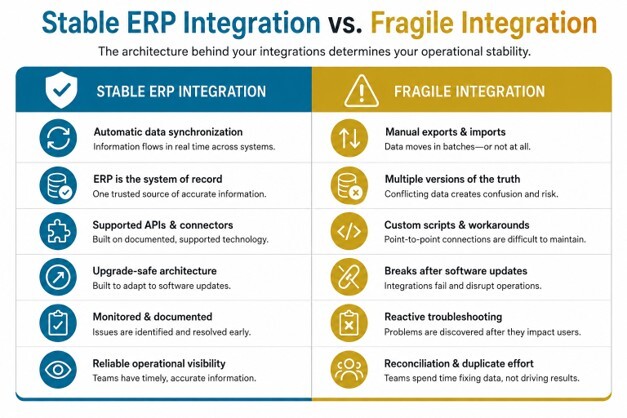
The goal isn't simply to connect software. It's to create a stable business environment where information flows reliably between systems, allowing people to focus on serving customers instead of correcting data.
Why do ERP integrations fail?
ERP integrations typically fail because they evolve over time without a clear architecture, governance, or long-term plan for managing change.
Most integration problems don't begin with a major system failure. They begin with good intentions.
A department needs information from another application, so someone builds a quick connection. Later, another team needs access to different data, so another connection is added.
It's a little like adding equipment to a production line without ever stepping back to redesign the workflow. Each addition solves an immediate problem, but over time the entire process becomes harder to maintain and far more sensitive to disruption. The business appears to be integrated because information usually gets where it needs to go, but the underlying connections are often more fragile than they appear.
That fragility rarely becomes obvious until something changes. A software update, a new application, a revised business process, or changing customer expectations can expose weaknesses that have existed all along.
Suddenly, shipments are delayed because inventory isn't synchronized.
Customer service spends valuable time answering questions caused by inconsistent information.
Finance invests additional effort reconciling reports before month-end close.
Small interruptions begin adding up across the business.
These issues aren't simply technical inconveniences. They create operational overhead:
- Employees spend more time investigating exceptions than completing routine work.
- Managers lose confidence in reports because different systems tell different stories.
- IT teams devote increasing amounts of time maintaining aging integrations instead of supporting new business initiatives.
What started as a practical short-term solution gradually becomes an ongoing operational cost.
That's why I encourage business leaders to think beyond whether data moves from one system to another. The more important question is whether those connections are stable enough to support future growth.
Reliable ERP integration isn't measured by whether it works today—it's measured by whether it continues working as the business, technology, and customer expectations evolve.
Which systems should integrate first?
Most manufacturers and distributors achieve the greatest value by integrating the systems that have the biggest operational impact first, rather than trying to connect everything at once.
Once leaders recognize the importance of ERP integration, it's tempting to tackle every connection on the wish list. After all, if connecting a few systems improves visibility, connecting all of them should be even better, right?
Not always. In reality, that's where many integration projects lose momentum.
Trying to integrate every system at once is like launching every product improvement at the same time. Even good ideas compete for attention, resources, and testing. Sequencing the work reduces risk and makes each improvement easier to validate before moving to the next.
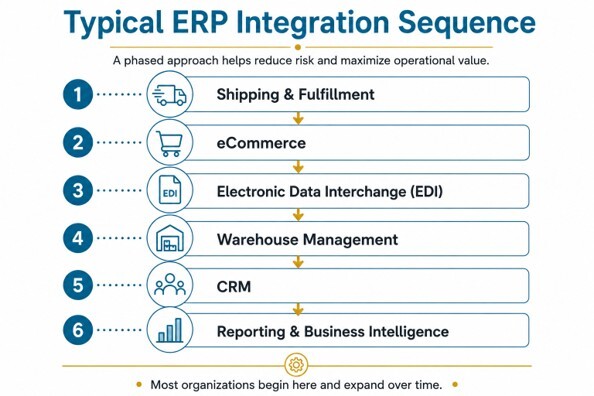
That's why I encourage businesses to prioritize integrations based on operational value rather than technical convenience. It's the systems that have the greatest impact on daily operations that typically deserve attention first.
For many manufacturers and distributors, that means beginning with shipping and fulfillment, followed by eCommerce, electronic data interchange (EDI), warehouse management, CRM, and reporting or business intelligence.
Every business is different, but the principle remains the same: start where better data and better visibility will have the greatest operational impact.
Remember: The goal isn't to connect the most systems. It's to connect the right systems in the right order.
What makes an integration upgrade-safe?
Upgrade-safe integrations are built using supported technologies, clear governance, and an architecture that can adapt as the business evolves.
One of the biggest misconceptions about ERP integration is that success is measured by whether everything works today.
A better measure is whether everything will still work after the next software update, business acquisition, process improvement, or new application. That's what separates an integration that solves today's problem from one that continues supporting the business for years to come.
Stable integration architecture typically shares three common characteristics:
1. Every business system has a clearly defined role.
The ERP remains the system of record for core business data, while connected applications exchange information through supported APIs, connectors, or middleware rather than unsupported customizations.
2. Integrations are monitored and governed.
Problems are identified early, responsibilities are clearly defined, and changes are documented so knowledge doesn't disappear when a key employee moves on.
3. The integration strategy grows with the business.
New applications are evaluated within the context of the overall architecture rather than being connected as isolated projects. That makes future improvements much easier to support without increasing unnecessary complexity.
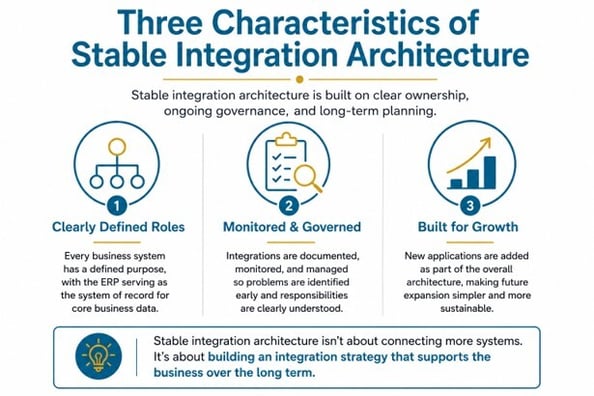
Think of it like expanding a manufacturing facility. If every addition follows the original site plan, the facility continues to operate efficiently as it grows. If each expansion is built independently, eventually the layout becomes harder to navigate, maintain, and improve. Integration architecture is no different.
The objective isn't simply to connect more systems. It's to create an integration strategy that's stable, scalable, and capable of supporting the business long after the initial implementation is complete.
How healthy is your integration structure?
You don't need to be an IT expert to evaluate the health of your integration strategy. Start with a few straightforward questions:
✔ Does our ERP serve as the system of record for core business data?
✔ Are our integrations built using supported APIs, connectors, or middleware rather than unsupported customizations?
✔ Can we identify who owns each integration and how it's monitored?
✔ Would a software upgrade create confidence—or concern?
✔ Are we adding new integrations as part of an overall architecture, or one project at a time?
✔ Do our connected systems improve operational visibility, or create additional reconciliation work?
If several of those questions are difficult to answer, it may be time to step back and evaluate the overall integration architecture rather than another individual connection.
Build a connected ERP ecosystem that lasts
ERP integration success isn't determined by how many systems are connected. It's determined by how well those systems work together over time.
Throughout this article, I've focused on a simple idea: stable integration architecture creates better operational visibility, more reliable data, and a stronger foundation for future growth. The businesses that benefit most aren't necessarily the ones with the most integrations. They're the ones with the right architecture supporting them.
ERP integration success depends on architecture, governance, and sequencing. Together, those three principles help manufacturers and distributors build an ERP environment that's stable today and prepared for tomorrow.
If you're wondering whether your current integration strategy is built for long-term success, an Integration Architecture Review can help identify opportunities to improve stability, reduce upgrade risk, and support future growth.
And before you go, I've answered a few of the most common ERP integration questions below for a quick reference.
Quick answers to common ERP integration questions
What does ERP integration mean?
ERP integration is the process of connecting an ERP system with other business applications so information moves automatically between systems. Effective integration improves operational visibility, reduces manual work, and helps ensure every department is working from the same reliable information.
Why do ERP integrations break?
Most ERP integrations break because they evolve over time without a clear architecture, governance, or ongoing monitoring. What begins as a practical short-term solution can gradually become difficult to maintain as software, business processes, and operational needs change.
What does upgrade-safe integration mean?
Upgrade-safe integration relies on supported APIs, connectors, and documented architecture rather than unsupported customizations or fragile point-to-point connections. That helps businesses adopt software updates with greater confidence and fewer disruptions.
What systems should integrate with SAP Business One?
Manufacturers and distributors commonly integrate SAP Business One with shipping platforms, warehouse management systems, eCommerce applications, electronic data interchange (EDI), CRM solutions, reporting tools, and other operational systems. The right priorities depend on where integration will deliver the greatest business value.
How do integrations affect inventory accuracy and shipping performance?
Reliable integrations help keep inventory, orders, and fulfillment information synchronized across connected systems. That reduces manual reconciliation, improves shipping accuracy, and gives employees greater confidence in the information they use every day.
Whether you're evaluating new integrations or improving existing ones, a thoughtful integration strategy helps create a more connected, reliable, and scalable ERP environment.