
Imagine spending a small fortune on a new ERP system, getting it up and running, and then never checking whether it delivered what you expected. It sounds like a strange way to manage an investment. Yet that's essentially what happens when companies stop evaluating their ERP business case after go-live.
Before implementation, everyone wants to talk about ROI. There are projections, spreadsheets, presentations, and plenty of discussion about how the new system will make the business more efficient. Faster financial closes. Better inventory management. Less manual work. Lower operating costs.
Then go-live arrives. The system works, the project is declared a success, and everyone can finally get back to their actual jobs. Meanwhile, those carefully documented expectations begin collecting digital dust.
I'm not suggesting that a successful SAP Business One implementation isn't worth celebrating. It absolutely is. But getting the software running was never the ultimate goal. Improving how the business operates was.
And that's where the real evaluation needs to begin.
In this first article in our three-part series on ERP value realization, I'll look at why the business case needs to remain a priority after go-live, how to tell whether the expected benefits are materializing, and who should be accountable for making sure they do. In the next two articles, we'll dig into measuring ERP ROI and why those returns sometimes fall short, even when the system itself works just fine.
Why should companies continue evaluating their ERP business case after go-live?
Companies should continue evaluating their ERP business case after go-live because even a successful implementation can't guarantee that the investment is delivering the financial and operational benefits they expected.
During implementation, no one has to be reminded that the ERP project exists. The meetings alone take care of that. Leadership reviews budgets and timelines. Project teams track milestones. Employees participate in testing and training.
And everyone wants to know whether the system will be ready on schedule.
Then the system goes live, and the focus suddenly shifts to keeping the business running. Which is understandable... after all, nobody wants to spend another six months talking about the ERP implementation.
But here's the problem: The original business case was never just about getting the software installed.
It was about what the business could accomplish once the new system was in place.
Consider a distributor that expected its new ERP system to reduce order-processing time by 30%. Six months after go-live, orders are moving through the system without major issues. That's encouraging.
But has processing time actually improved? Are employees spending fewer hours correcting orders? Has the business gained the capacity to handle more volume?
Without revisiting those original expectations, leadership may never know.
This challenge isn't unique to ERP. McKinsey's research on sustaining value after implementation emphasizes that achieving lasting business improvements requires continued attention after a transformation is delivered.
The point isn't to keep the implementation project open indefinitely. It's to make sure someone is still paying attention to the results.
So the real measure of success isn't whether the ERP system went live on schedule. It's whether the business is better off because of it.
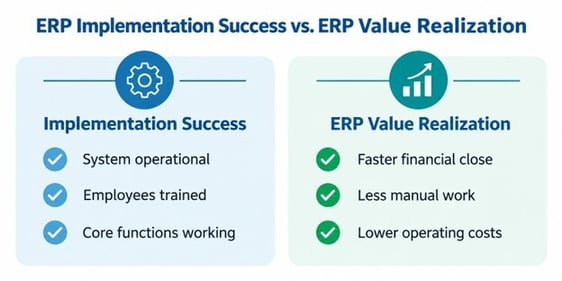
What is ERP value realization, and how is it different from ERP implementation success?
ERP value realization is the process of turning an ERP investment into measurable financial and operational improvements. ERP implementation success, on the other hand, means the system is operational, its core functions work as intended, and employees can use it to run the business.
Both matter, but they're not the same thing.
For example, a manufacturer might successfully implement a new ERP system that brings purchasing, production, inventory, and financial data together. That's no small achievement. But consider what happens six months later:
- The finance team has access to better information, but closing the books still takes two weeks.
- Inventory records are more accessible, but employees continue using separate spreadsheets because they don't fully trust the numbers.
- Purchasing and production teams use the same system, but coordinating material requirements still involves a steady stream of emails and phone calls.
Technically, the system may be doing exactly what it was designed to do. The business, however, hasn't necessarily changed how it operates.
That's the distinction behind ERP benefits realization. The value doesn't come simply from having new capabilities. It comes from using those capabilities to improve processes, reduce unnecessary work, and make better decisions.
Deloitte touches on this in its research on delivering business impact through ERP transformation, emphasizing the importance of connecting technology investments to measurable business outcomes.
This is also why ERP business benefits need to be defined in practical terms. "Better reporting" sounds promising, but what does it actually mean? Can managers get the information they need without waiting for someone to assemble it? Are they making decisions sooner? Is the finance team spending less time preparing reports and more time analyzing them?
Those are the kinds of improvements that turn a successful implementation into a successful investment.
Why don't expected ERP business benefits always materialize?
Expected ERP business benefits don't always materialize because new technology doesn't automatically change the way people work.
Think about a distributor that invested in ERP partly to reduce manual order processing. The new system had the functionality to automate a lot of that work, but employees were still printing orders for approval or maintaining separate spreadsheets to track exceptions. The technology was available to them. But the old process was still running the show.
There are several reasons this happens:
- Old habits survive. Employees continue using familiar processes because they're comfortable with them, even when the new system offers a better approach.
- Workarounds become permanent. Spreadsheets and manual steps introduced during implementation never quite disappear.
- Capabilities go unused. Employees don't always know what the system can do, so features that could save time or improve reporting sit unused.
- Data problems persist. Inconsistent or unreliable information makes it difficult for employees to trust the system or use it effectively.
- Nobody owns the improvements. Once the implementation team moves on, responsibility for addressing these issues becomes unclear.
None of these problems necessarily means the ERP implementation failed. But they can prevent the business from realizing the returns it expected.
As I discuss in The Long-term Cost of ERP Mistakes in Manufacturing, seemingly small inefficiencies and workarounds can accumulate into significant operational costs over time.
The important question isn't simply whether the ERP system has the capabilities the business needs. It's whether those capabilities are being used to produce better results.
How should leadership measure the financial return on ERP?
Leadership should measure ERP return on investment by comparing the financial and operational improvements the business expected with the results it's actually achieving after go-live.
That means going back to the original ERP business case and asking a few practical questions. Are we saving the time we expected to save? Have operating costs come down? Can we handle more business without adding people or creating more administrative work?
The answers won't always appear neatly on a financial statement.
For example, a distributor might have expected its ERP investment to improve inventory management. The financial return could show up in lower carrying costs, fewer emergency purchases, or less cash tied up in excess stock. A manufacturer might see value in shorter production delays, fewer manual reconciliations, or better visibility into material requirements.
Other improvements are worth measuring, too:
- Financial close: Is the accounting team closing the books faster?
- Administrative effort: Are employees spending fewer hours entering, correcting, or reconciling information?
- Reporting: Can managers get reliable information without waiting for someone to assemble it?
- Growth capacity: Can the business handle more transactions without a corresponding increase in overhead?
Of course, these improvements need to be weighed against the full cost of the investment, including ongoing expenses. That's something I discuss in Understanding ERP Implementation Costs.
The goal isn't to prove that every projected benefit materialized exactly as planned. It's to understand what's improving, what isn't, and where the business still has opportunities to get more from its investment.
In the second article in this series, I'll get into the specific metrics and calculations that can help leadership put real numbers behind those improvements.
Who is responsible for ensuring ERP delivers business value after go-live?
Responsibility for ensuring ERP delivers business value after go-live belongs to business leadership, with finance, operations, and IT each playing a role in making sure the expected improvements actually happen.
It's tempting to leave this responsibility with the IT team. After all, they're the ones keeping the system running, managing updates, and addressing technical issues.
But asking IT to take responsibility for ERP's financial return is like asking the mechanic who maintains your delivery fleet why your shipping costs haven't come down.
The trucks may be running beautifully, but that's only part of the equation.
The same goes for ERP. IT can make sure the system works, but it can't single-handedly improve inventory management, streamline financial processes, or change how employees do their jobs.
Those are business outcomes, and someone needs to own them.
Here's my take on how the responsibilities should be divided:
- Finance leadership: The CFO or finance team should track whether the investment is delivering the expected financial returns, including cost savings, productivity improvements, and working capital benefits.
- Operations leadership: The COO and department managers should be accountable for improving the processes the ERP system supports, from inventory management to order fulfillment and production planning.
- IT leadership: IT should maintain system reliability, support integrations, and help the business take advantage of capabilities that support its goals.
- Executive leadership: The leadership team needs to keep ERP benefits realization on the agenda, resolve competing priorities, and make sure improvement efforts don't lose momentum.
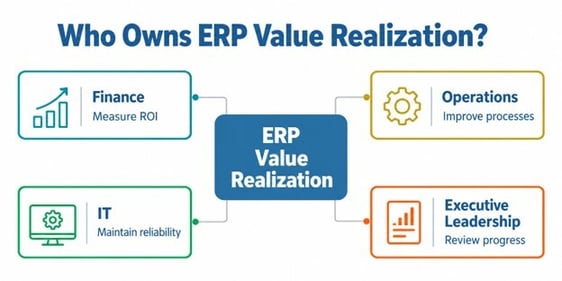
The key is to assign clear ownership to the improvements identified in the original business case and review progress regularly.
When nobody is responsible for the results, it's easy for ERP post-implementation activities to become a series of support requests rather than an ongoing effort to improve business performance.
The system may be working perfectly well. But someone still needs to make sure the business is getting its money's worth.
How can companies sustain ERP value through continuous improvement?
Companies can sustain ERP value by making ERP continuous improvement part of how they manage the business, rather than treating optimization as something to revisit only when problems arise.
That doesn't mean launching another major project every year. It means regularly asking whether the system and the processes around it are delivering the results the business needs.
What if leadership started asking a few questions each quarter?
- Are employees still relying on spreadsheets or manual workarounds?
- Are there capabilities we're paying for but not fully using?
- Have changes in the business created new bottlenecks?
- Which improvements would make the biggest difference to costs, productivity, or customer service?
The answers should lead to specific actions, with someone responsible for following through.
And as the business grows, those priorities will change. A process that worked well at go-live may need attention two years later when order volumes have doubled or the company has added another location.
There's more to this story, of course. In the third article of this series, I'll look at the habits and missed opportunities that can keep businesses from getting the returns they expected.
Continuous improvement isn't about changing the ERP system just for the sake of changing it. It's about getting more value from what you've already invested in.
A successful ERP implementation is worth celebrating. But the real test comes in the months and years that follow, when the business has an opportunity to turn new capabilities into better financial and operational results.
Your ERP business case shouldn't be something you file away after go-live. Think of it as a roadmap for what comes next, helping you decide what to measure, where to improve, and how to get more from the investment you've already made.
And if the returns aren't quite what you expected? That's not necessarily a sign that you chose the wrong system. It may mean there's more work to do to realize its full potential.
Not sure your ERP investment is delivering everything you expected? Let's talk about where there may be opportunities to get more from the system you already have.